
Overview
Heart Rate Variability is a key metric that can help us to understand our heart’s adaptability to different situations, providing an insight into stress levels, and overall health and well-being.
Even if our Heart Rate measures a constant 100bpm over many minutes, it is possible that there are small differences in the time between each adjacent beat, but the average still adds up to 100bpm overall. These differences between beats are the small variations that HRV represents. These are not changes in your heart rate, but a measure of how your heart doesn’t keep exact time compared to a metronome beat when your HRV is high, but will keep much stricter time with the same beat when HRV is low. High HRV is related to a relaxed or parasympathetic nervous system state. Low HRV is related to a focused, fight or flight state, where the sympathetic nervous system is dominant. HRV is linked to the autonomic nervous system, with higher HRV associated with rest-and-digest and lower HRV with stress (such as intense or sudden activity), anxiety or illness.
It is not possible to compare your HRV measurements with those from other people, even in similar states of fitness or with similar health conditions. HRV is totally unique to each individual. Monitoring your HRV over time can help determine what’s normal for you, or when something isn’t right and you might need to consider resting more.
Although the measurement method is the same for most Apps (apart from Apple), two different approaches are used to both calculating the numbers (direct measurement in milliseconds vs calculating a score) and what time of day the measurement should be taken (average overnight, vs single measurement upon waking).
With ME/CFS and Long Covid, it has been documented in a pre-print study titled Wearable heart rate variability monitoring identifies autonomic dysfunction and thresholds for post-exertional malaise in Long COVID by Rob Wüst, that during exercise, low HRV is a good indicator of stress caused by exceeding your anaerobic heart rate threshold. There is a great overview of this study (by Cort Johnson at HealthRising) here, titled: Too Much Exertion Produces Autonomic Nervous System Hit in Long COVID, ME/CFS, and Fibromyalgia.
It is notable that in the review study An Overview of Heart Rate Variability Metrics and Norms the conventional minimum measurement period is 5 minutes. Ultra-short-term periods (60, 30 seconds or less) have been proposed but with a risk of decreasing accuracy and reliability.
Two typical wearable devices are shown below, both able to measure HRV, but using different measurement frequency and duration approaches.
Oura App Approach
Oura presents multiple HRV measurements taken overnight, as well as an average. Daytime measurements or even short periods awake are not included in the average calculation.
You can see from the image below that HRV can fluctuate considerably, and that taking a single random measurement around the time of waking could result in an enormous difference in the HRV presented – Averaging whilst sleeping has clear advantages.
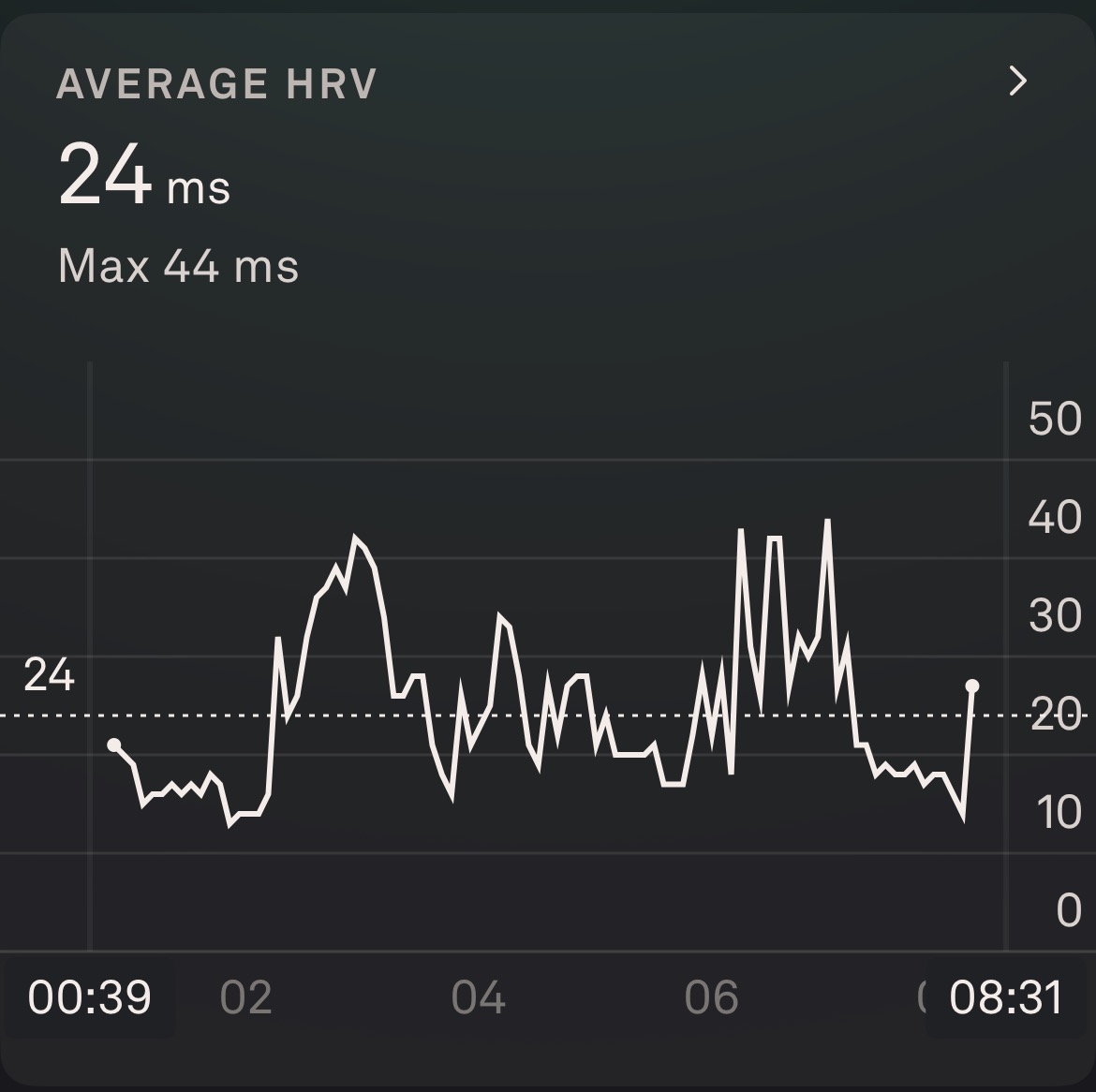
Oura measures continuously each five minutes overnight, so 96 readings for an 8 hour sleep. Each HRV measurement is shown as measured naturally in milliseconds, calculated using the RMSSD (or Root Mean Square of Successive Differences) method. The disadvantage with this method is that for low values of HRV, small differences in HRV from one day to another for a low value (e.g. 10ms) are much more significant than for a high value (e.g. 50ms). For this reason, EliteHRV and Visible below use a “log” function to present a score that’s more easily interpretable by a person.
EliteHRV / Visible App Approach
EliteHRV (manufacturer of a well known App for measuring HRV) approach is to produce a score in the range 0-100, using the measured HRV in milliseconds and adjusting it using a function based on the log of the HRV and a scaling factor, which includes your age.
A simplification of this method is illustrated by the following examples:
- HRV of 10ms, so ln(10) gives 2.30, multiply by ~15.5 (for age 55) gives an HRV score of 35
- HRV of 35ms, so ln(35) gives 3.55, multiply by ~15.5 (for age 55) gives an HRV score of 55
The value of 15.5 I chose above is a great simplification, but gives the general idea. EliteHRV have calculated their own bespoke functions to produce HRV Scores based on HRV in milliseconds, taking into account variations in Age Range and Gender, as below.
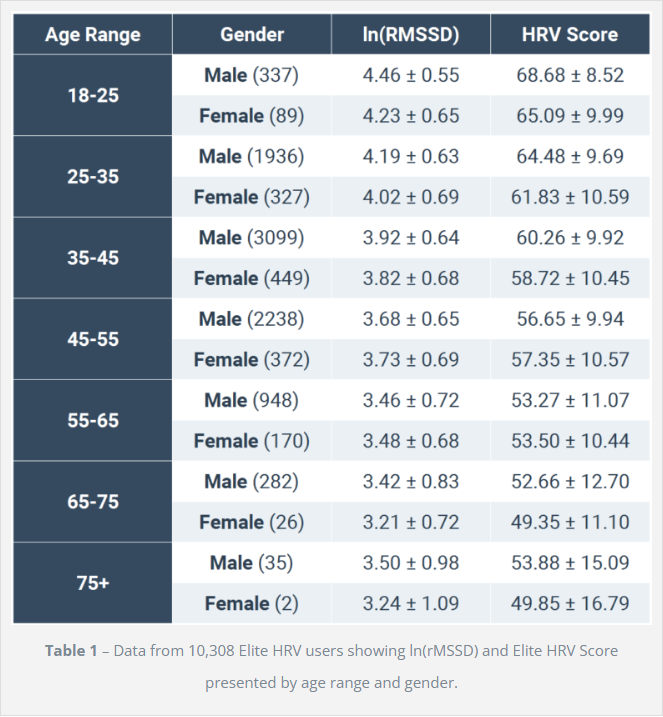
(Image above courtesy of Elite HRV, from https://elitehrv.com/normal-heart-rate-variability-age-gender)
Because HRV changes rapidly based on mood and how you wake up, EliteHRV have published good guidelines on when and how to take your HRV measurement in the morning. This is a useful guide for those who take a single reading each day, such as with the current version of the Visible Armband and App.
The Visible armband measurement frequency is daily each morning, and the measurement is taken over a period of between 60 and 90 seconds.
My typical morning routine when using Visible:
- Wake and perform the measurement before anything like showering, climbing stairs or especially eating
- Use the toilet (a full bladder has often caused very low HRV readings)
- Put on my wearable, if not worn overnight
- Sip some water if needed
- Sit up, in bed, and relax to prepare for my reading
- Take HRV reading
I don’t need to follow these steps with Oura, as it takes an average of ~100 readings overnight.
Pros and Cons of Overnight vs Morning Measurement for People with ME
HRV seems very sensitive to measurement conditions and particularly any changes in activity when the measurement is taken. This initially suggests that an overnight measurement might give a more stable measurement and it does appear to, but for fitness enthusiasts, it is recommended to measure first thing in the morning after waking, but before doing any vigorous exercise. This is because the measurement instead of being passive, is effectively measuring the body ‘under load’. Day to day changes in HRV can be exaggerated even mild load. The problem for People with ME is that even the mere act of sitting up in bed can place the body considerably under load and if not relaxed e.g. because you need to use the bathroom before measurement, many are doing the equivalent (in terms of activity) as going for a morning run might be for a healthy person.
So for People with ME, after getting comfortable, how long should you wait in order to be measuring under similar conditions each day? And I thing the answer is that guaranteeing similar conditions after waking is almost impossible for People with ME. Which brings us all the way back to favouring an average of multiple overnight HRV measurements rather than a single morning measurement.
Daytime HRV and Stress Measurement
Daytime HRV measurements for People with ME are still very relevant, because when HRV drops rapidly and disproportionately to identifiable activity (if any) this can be interpreted as stress. Identifying stress (as Oura does) using Heart Rate Variability (HRV), Resting Heart Rate, Skin temperature, and Movement may give a good indication of when an activity might lead to a disproportionate outcome, including Post Exertional Malaise.
Reference Links
Oura Documents:
The Oura documents below about Heart Rate Variability many written or contributed to by Oura’s HRV expert Marco Altini (an HRV specialist & data scientist, with a background in computer science and physiology). These are excellent reference material:
- What Is Heart Rate Variability (HRV)?
- What Is the Average HRV?
- Why Oura Uses The Entire Night Of HRV Data
- 8 Myths About HRV, Debunked
- What Causes Low HRV During Sleep?