‘Reflect, Collaborate and Listen’ looks at why doctors don’t listen and the urgent need to rebalance the power dynamic in the patient – doctor relationship.
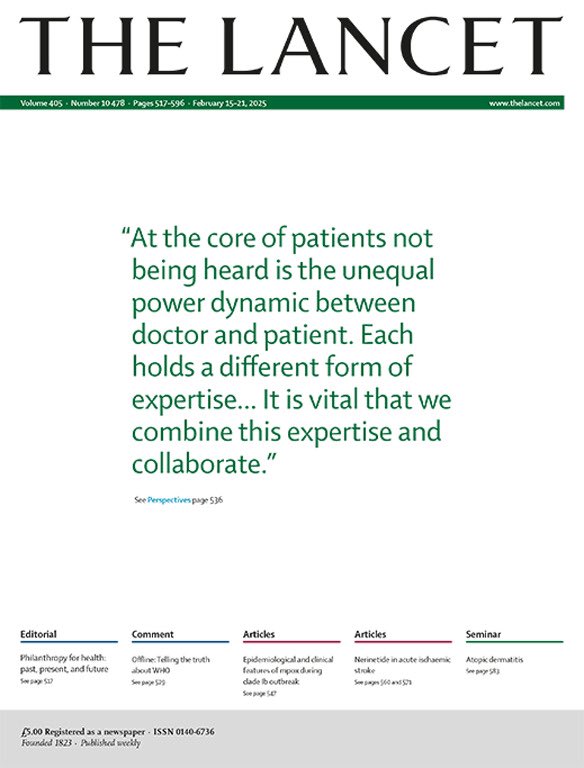
✨My essay in @TheLancet this week has made the front page!✨ (I didn’t know about this 🤗)
‘Reflect, Collaborate and Listen’ looks at why doctors don’t listen and the urgent need to rebalance the power dynamic in the patient – doctor relationship.https://t.co/TusGTRBa8fpic.twitter.com/BmUVuYccmw
Suzanne D. Vernon PhD, Tianyu Zheng MS, Hyungrok Do PhD, Vincent C. Marconi MD, Leonard A. Jason PhD, Nora G. Singer MD, Benjamin H. Natelson MD, Zaki A. Sherif PhD, Hector Fabio Bonilla MD, Emily Taylor MA, Janet M. Mullington PhD, Hassan Ashktorab PhD, Adeyinka O. Laiyemo MD, Hassan Brim PhD, Thomas F. Patterson MD, Teresa T. Akintonwa BA, Anisha Sekar BA, Michael J. Peluso MD, Nikita Maniar MD, Lucinda Bateman MD, Leora I. Horwitz MD & Rachel Hess MD on behalf of the NIH Researching COVID to Enhance Recovery (RECOVER) Consortium
Abstract
Background
Myalgic encephalomyelitis/chronic fatigue syndrome (ME/CFS) may occur after infection. How often people develop ME/CFS after SARS-CoV-2 infection is unknown.
Objective
To determine the incidence and prevalence of post-COVID-19 ME/CFS among adults enrolled in the Researching COVID to Enhance Recovery (RECOVER-Adult) study.
Design, Setting, and Participants
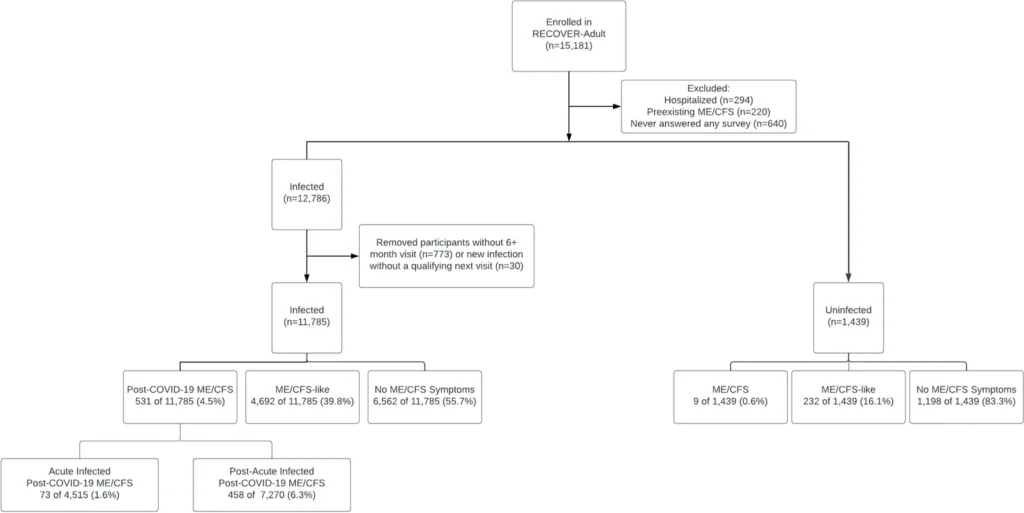
RECOVER-Adult is a longitudinal observational cohort study conducted across the U.S. We included participants who had a study visit at least 6 months after infection and had no pre-existing ME/CFS, grouped as (1) acute infected, enrolled within 30 days of infection or enrolled as uninfected who became infected (n=4515); (2) post-acute infected, enrolled greater than 30 days after infection (n=7270); and (3) uninfected (1439).
Measurements
Incidence rate and prevalence of post-COVID-19 ME/CFS based on the 2015 Institute of Medicine ME/CFS clinical diagnostic criteria.
Results
The incidence rate of ME/CFS in participants followed from time of SARS-CoV-2 infection was 2.66 (95% CI 2.63–2.70) per 100 person-years while the rate in matched uninfected participants was 0.93 (95% CI 0.91–10.95) per 100 person-years: a hazard ratio of 4.93 (95% CI 3.62–6.71). The proportion of all RECOVER-Adult participants that met criteria for ME/CFS following SARS-CoV-2 infection was 4.5% (531 of 11,785) compared to 0.6% (9 of 1439) in uninfected participants. Post-exertional malaise was the most common ME/CFS symptom in infected participants (24.0%, 2830 of 11,785). Most participants with post-COVID-19 ME/CFS also met RECOVER criteria for long COVID (88.7%, 471 of 531).
Limitations
The ME/CFS clinical diagnostic criteria uses self-reported symptoms. Symptoms can wax and wane.
Conclusion
ME/CFS is a diagnosable sequela that develops at an increased rate following SARS-CoV-2 infection. RECOVER provides an unprecedented opportunity to study post-COVID-19 ME/CFS.
Released as version 1.0 today, a new and outstandingly comprehensive reference guide for both Doctors and Health Care Workers. The reference guide we needed 20 years ago! This certainly feels like an essential training reference:
“A Roadmap to Better Care: Clinical Care Guide for ME/CFS, Long COVID & Infection-Associated Chronic Conditions
Developed by the OMF-supported Medical Education Resource Center (MERC) at Bateman Horne Center, this resource offers a practical path forward—one grounded in clinical expertise, research, and the lived experience of patients”
Please share – A very important campaign was launched on the evening of 29th August 2025 to help provide legal support for targeting improvements in medical care, thereby benefiting everyone with ME or Long Covid induced illness.
“Campaigning for ME (Myalgic Encephalomyelitis) to be medically managed safely, to protect families from permanent disability or death from neglect of the illness”
Find history, campaign details information and endorsements available on on the Crowd Justice site via the following link: justice4me.uk
Update 31/08/2025 – On a public facing Facebook comment, where some were discussing the nature of the campaign and potential legal cases, in answer to a question raised by an ME patient, Sarah Boothby (one of the endorsers of the campaign and mother of Maeve Boothby O’Neill, who tragically died from ME in October 2021 aged only 27) shared her understanding of what she believes #JusticeForME is intending (my bold, for emphasis, below):
“It is a case against the government, for neglecting to deliver a specialist health service in its Final Delivery Plan for ME/cfs.
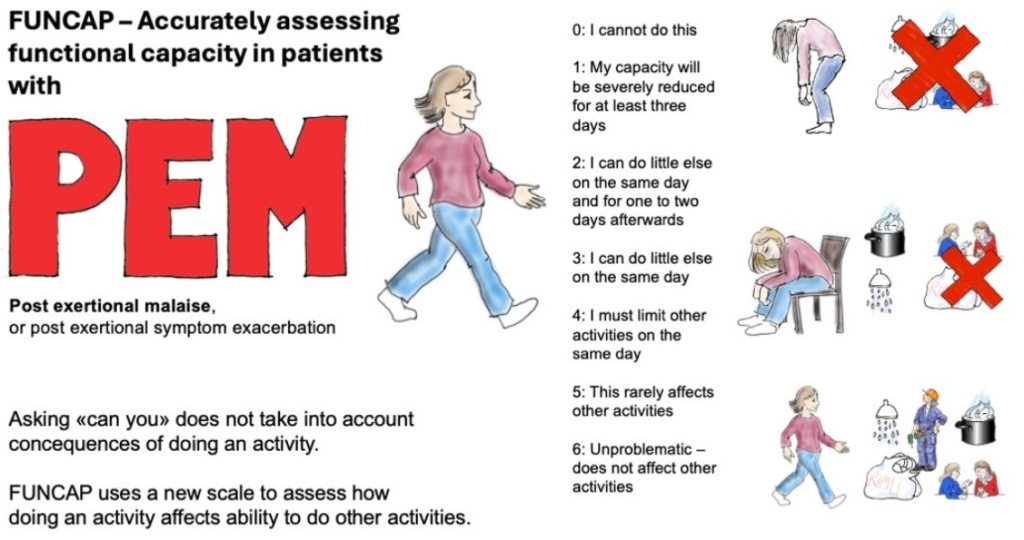
Without Consultant led NHS specialist services everyone with #ME in England is denied access to the disability rights other medical conditions are given as granted and, if/when they need hospital treatment, no provision is made for the specialist nursing care demanded by the nature of the illness (hypersensitivies to all sensory stimuli that increase with #PEM). This automatically triggers the worst PEM ever – adding years of the most horrible symptoms to an already horrible illness. The campaign is to stop this neglect.”
As of this evening (31/08/2025), the campaign has astonishingly already received over £5,000 in pledges of first target of £6,000 within 48 hours of launch, with 28 days still remaining.
Full details and donations via the link here, taking you to Crowd Justice: justice4me.uk
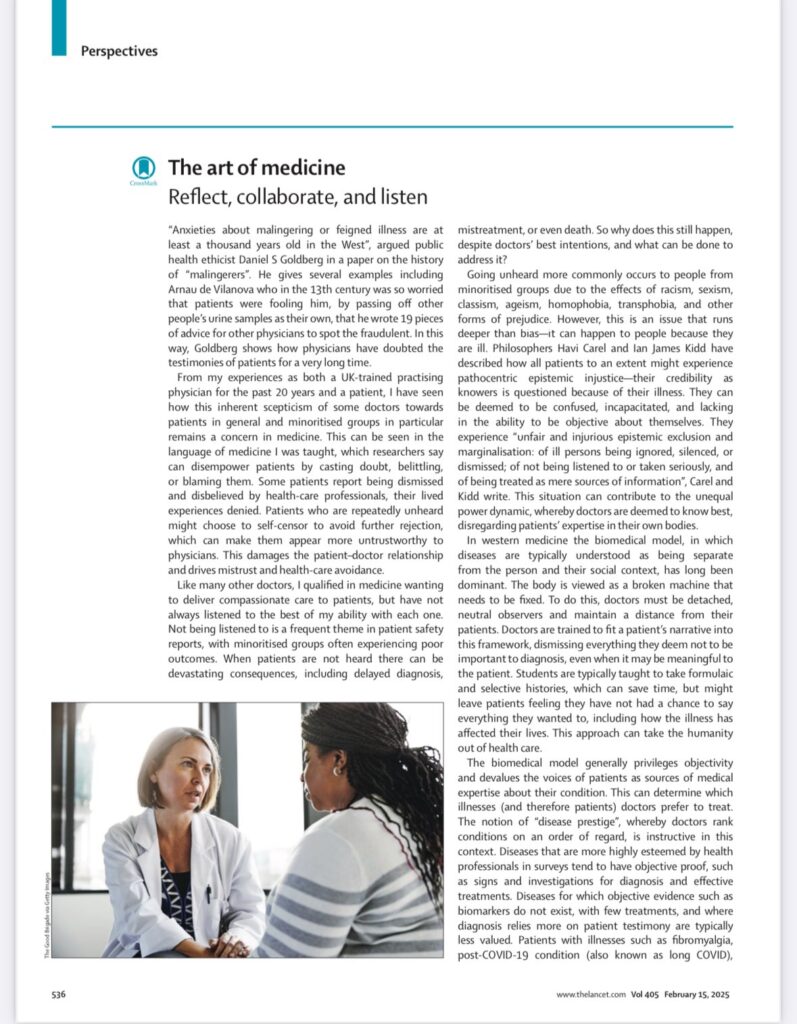
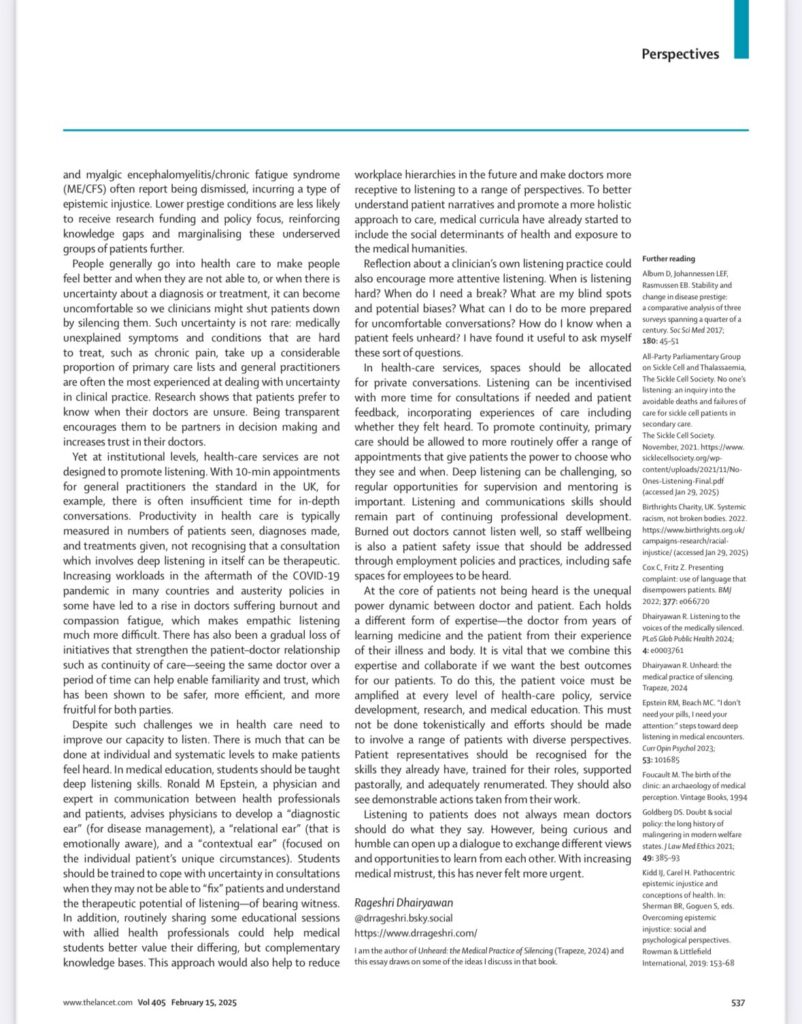
Dr Rageshri Dhairyawan writes “Reflect, Collaborate and Listen” which examines why doctors don’t listen, and the urgent need to rebalance the power dynamic in the patient – doctor relationship.”
See the full article here in the Lancet – It is free to download (after registration, which is quite easy).
The abstract continues: “Anxieties about malingering or feigned illness are at least a thousand years old in the West”, argued public health ethicist Daniel S Goldberg in a paper on the history of “malingerers”. He gives several examples including Arnau de Vilanova who in the 13th century was so worried that patients were fooling him, by passing off other people’s urine samples as their own, that he wrote 19 pieces of advice for other physicians to spot the fraudulent. In this way, Goldberg shows how physicians have doubted the testimonies of patients for a very long time.
A preprint study from Yale University appears to identify individuals suffering from PVS with elevated levels of circulating isolated spike protein, compared to healthy controls, implying that the source is from a vaccine. Those studied had no prior history or evidence of a SARS-Cov2 infection.
Researchers have since publication pointed out that Long Covid existed significantly before vaccines were available, defending suggestions from some that Long Covid had somehow been caused purely as a result of vaccination. This is not the case, and PVS forms a very small subset of those suffering with Long Covid Symptoms.