|

Why Doctors don’t Reflect, collaborate, and listen

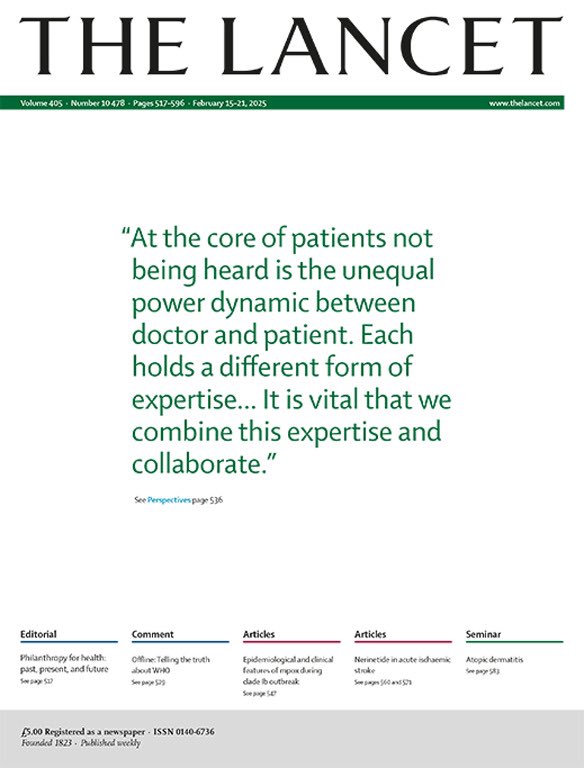
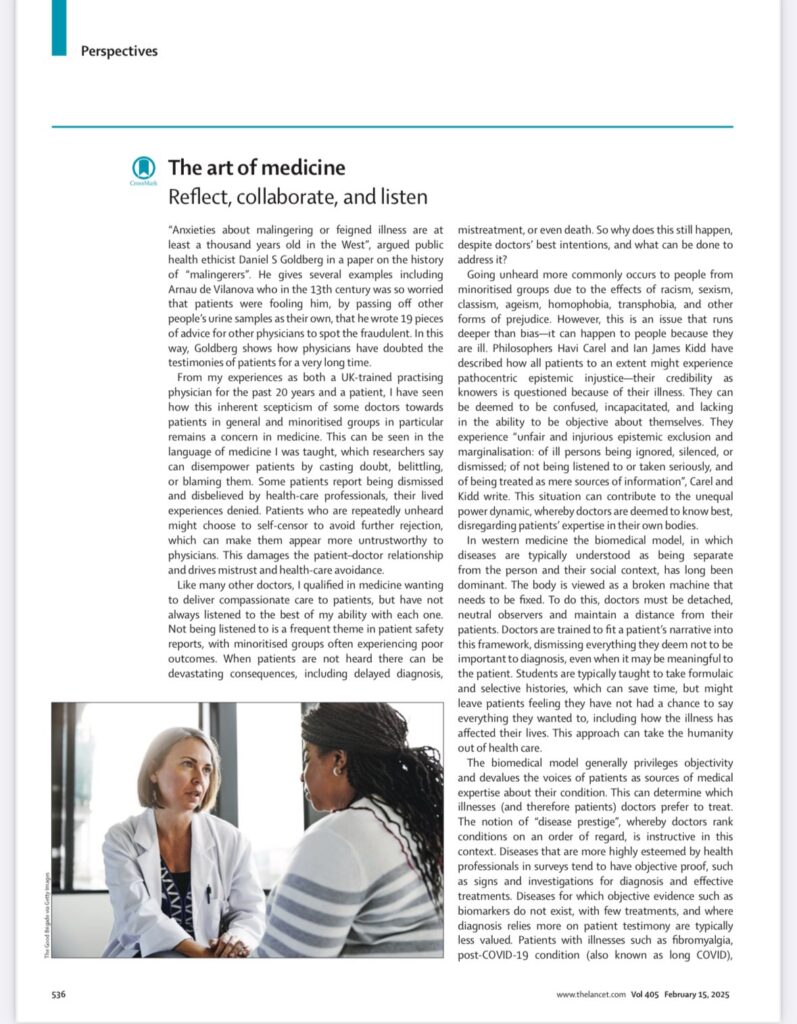
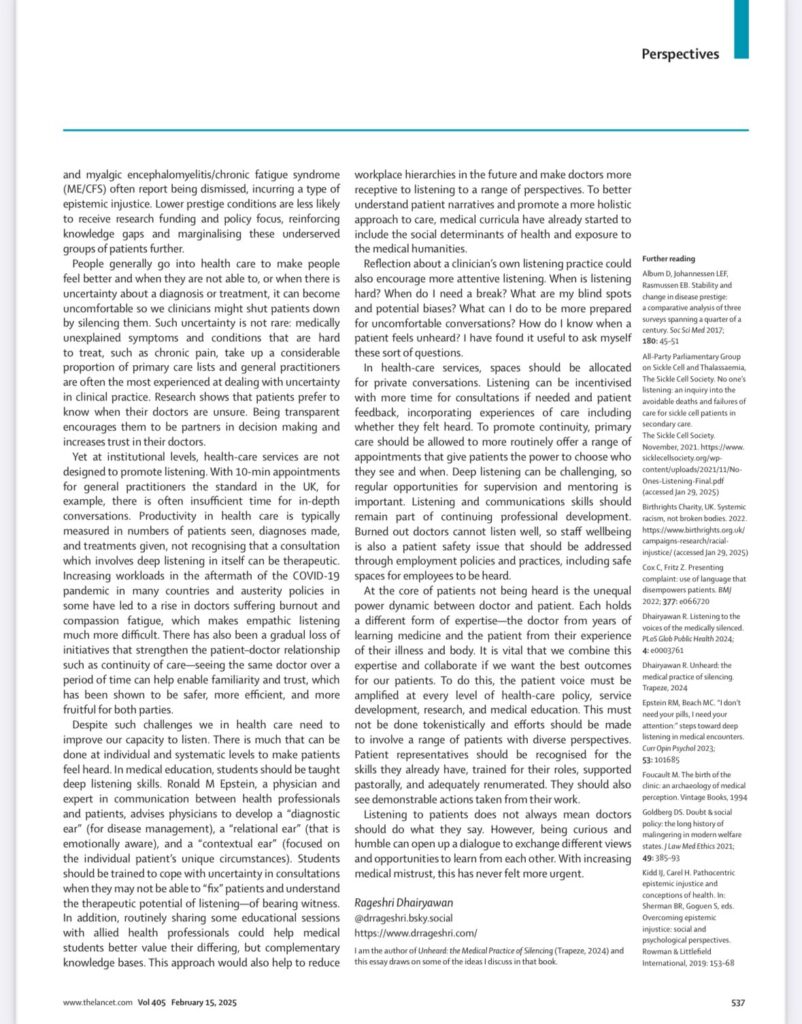
Dr Rageshri Dhairyawan writes “Reflect, Collaborate and Listen” which examines why doctors don’t listen, and the urgent need to rebalance the power dynamic in the patient – doctor relationship.”

See the full article here in the Lancet – It is free to download (after registration, which is quite easy).

The abstract continues: “Anxieties about malingering or feigned illness are at least a thousand years old in the West”, argued public health ethicist Daniel S Goldberg in a paper on the history of “malingerers”. He gives several examples including Arnau de Vilanova who in the 13th century was so worried that patients were fooling him, by passing off other people’s urine samples as their own, that he wrote 19 pieces of advice for other physicians to spot the fraudulent. In this way, Goldberg shows how physicians have doubted the testimonies of patients for a very long time.

Similar Posts

  • Preprint – Incidence and Prevalence of Post-COVID-19 Myalgic Encephalomyelitis: A Report from the Observational RECOVER-Adult Study

    Published: 13 January 2025

    Suzanne D. Vernon PhD, Tianyu Zheng MS, Hyungrok Do PhD, Vincent C. Marconi MD, Leonard A. Jason PhD, Nora G. Singer MD, Benjamin H. Natelson MD, Zaki A. Sherif PhD, Hector Fabio Bonilla MD, Emily Taylor MA, Janet M. Mullington PhD, Hassan Ashktorab PhD, Adeyinka O. Laiyemo MD, Hassan Brim PhD, Thomas F. Patterson MD, Teresa T. Akintonwa BA, Anisha Sekar BA, Michael J. Peluso MD, Nikita Maniar MD, Lucinda Bateman MD, Leora I. Horwitz MD & Rachel Hess MD on behalf of the NIH Researching COVID to Enhance Recovery (RECOVER) Consortium

    Abstract

    Background

    Myalgic encephalomyelitis/chronic fatigue syndrome (ME/CFS) may occur after infection. How often people develop ME/CFS after SARS-CoV-2 infection is unknown.

    Objective

    To determine the incidence and prevalence of post-COVID-19 ME/CFS among adults enrolled in the Researching COVID to Enhance Recovery (RECOVER-Adult) study.

    Design, Setting, and Participants

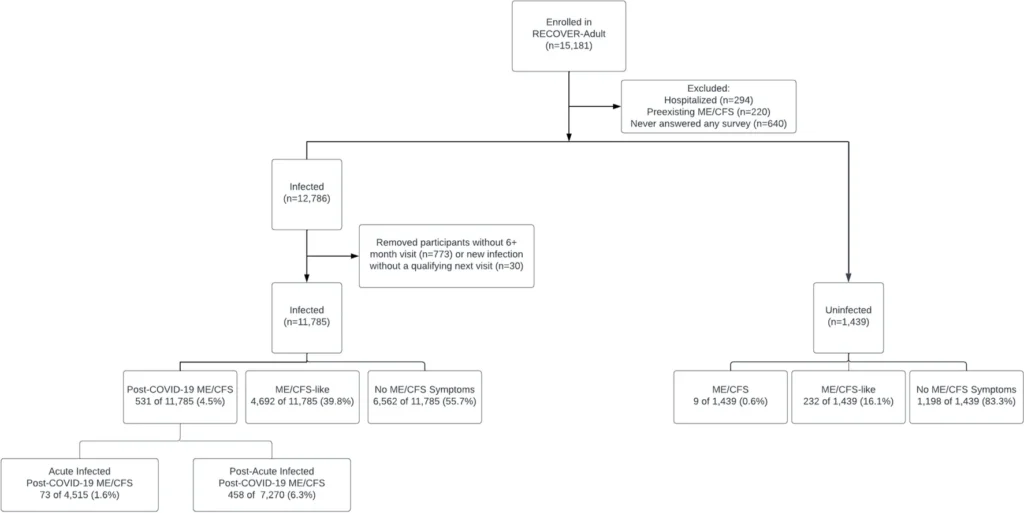
    RECOVER-Adult is a longitudinal observational cohort study conducted across the U.S. We included participants who had a study visit at least 6 months after infection and had no pre-existing ME/CFS, grouped as (1) acute infected, enrolled within 30 days of infection or enrolled as uninfected who became infected (n=4515); (2) post-acute infected, enrolled greater than 30 days after infection (n=7270); and (3) uninfected (1439).

    Measurements

    Incidence rate and prevalence of post-COVID-19 ME/CFS based on the 2015 Institute of Medicine ME/CFS clinical diagnostic criteria.

    Results

    The incidence rate of ME/CFS in participants followed from time of SARS-CoV-2 infection was 2.66 (95% CI 2.63–2.70) per 100 person-years while the rate in matched uninfected participants was 0.93 (95% CI 0.91–10.95) per 100 person-years: a hazard ratio of 4.93 (95% CI 3.62–6.71). The proportion of all RECOVER-Adult participants that met criteria for ME/CFS following SARS-CoV-2 infection was 4.5% (531 of 11,785) compared to 0.6% (9 of 1439) in uninfected participants. Post-exertional malaise was the most common ME/CFS symptom in infected participants (24.0%, 2830 of 11,785). Most participants with post-COVID-19 ME/CFS also met RECOVER criteria for long COVID (88.7%, 471 of 531).

    Limitations

    The ME/CFS clinical diagnostic criteria uses self-reported symptoms. Symptoms can wax and wane.

    Conclusion

    ME/CFS is a diagnosable sequela that develops at an increased rate following SARS-CoV-2 infection. RECOVER provides an unprecedented opportunity to study post-COVID-19 ME/CFS.

    Read the full preprint article here: https://link.springer.com/article/10.1007/s11606-024-09290-9

  • Hidden Illness, Public Grief, and Research Funding: Why ME/CFS and Other Gradual-Onset Conditions Struggle for Recognition

    Author: Steve Fifield 3rd March 2026

    I wrote a simple draft paper on possible reasons why ME/CFS and similar conditions struggle so much for public recognition and funding.

    Executive Summary

    This briefing paper proposes that illnesses characterised by gradual onset, symptom invisibility, and ambiguous loss—such as Myalgic Encephalomyelitis/Chronic Fatigue Syndrome (ME/CFS)—face structural disadvantages in public recognition and research funding.

    In contrast to diseases associated with sudden, catastrophic diagnoses (e.g., cancer, motor neurone disease, multiple sclerosis), ME/CFS often progresses gradually, without a singular crisis moment that mobilises families, media, and policymakers.

    Drawing on psychological research, communication theory, medical sociology, and health policy analysis, this paper outlines evidence supporting the hypothesis that acute grief catalyses mobilisation, while chronic ambiguity fosters adaptation rather than advocacy.

    1. Proposition Statement

    Public support for disease research funding is strongly influenced by emotional salience, narrative clarity, and visibility.

    • This paper proposes that:
    • Sudden, high-intensity diagnoses generate collective grief and advocacy mobilisation.
    • Gradual, invisible illness trajectories tend to produce adaptation and normalisation rather than public outrage.
    • Conditions lacking clear biomarkers or dramatic ‘trigger events’ may remain socially marginalised and underfunded.

    2. Psychological Evidence: Emotion, Grief, and Giving

    Research in behavioural psychology demonstrates that emotional intensity significantly influences charitable giving and advocacy behaviour.

    • Key evidence includes:
    • The ‘Identifiable Victim Effect’ shows individuals donate more readily when harm is concrete and personal (Small & Loewenstein, 2003).
    • Personal experience with illness strongly predicts sustained advocacy engagement (Bekkers & Wiepking, 2011).
    • Acute grief produces action-oriented coping responses, whereas ambiguous loss can lead to prolonged emotional adjustment rather than mobilisation (Boss, 1999).

    3. Media Visibility and Agenda Setting

    Agenda-setting research demonstrates that media coverage shapes public perceptions of issue importance (McCombs & Shaw, 1972).

    • Relevant dynamics:
    • Diseases with dramatic diagnostic narratives are more likely to receive concentrated media attention.
    • High-visibility campaigns (e.g., viral fundraising movements) significantly increase funding inflows.
    • Invisible or contested illnesses struggle to achieve sustained media framing as urgent biomedical crises.

    4. Medical Sociology: Invisible and Contested Illness

    ME/CFS has historically been classified as a contested or medically unexplained illness.

    • Sociological findings show:
    • Illnesses lacking objective biomarkers often face legitimacy challenges (Barker, 2008).
    • Symptom invisibility contributes to stigma and disbelief (Dickson et al., 2007).
    • Gradual functional decline may be socially normalised within families, reducing collective mobilisation.

    5. Research Funding and Disease Burden

    Multiple analyses indicate that biomedical research funding does not consistently align with disease burden.

    • Findings relevant to ME/CFS:
    • Funding levels for ME/CFS have historically been substantially lower than expected based on disability-adjusted life years (DALYs) (Dimmock et al., 2016).
    • Mortality salience and media visibility correlate more strongly with funding allocation than chronic disability alone.
    • Conditions perceived as life-threatening often secure greater political and philanthropic urgency.

    6. Policy and Strategic Implications

    If this proposition is valid, important implications follow for research institutions, advocacy organisations, and policymakers.

    • Potential strategies:
    • Develop narrative frameworks that communicate cumulative functional loss without sensationalism.
    • Align funding mechanisms more closely with disease burden metrics rather than media salience.
    • Invest in biomarker research to strengthen clinical legitimacy.
    • Promote public education campaigns that clarify the biological basis and severity of ME/CFS.

    Conclusion

    ME/CFS exemplifies how gradual-onset, invisible illnesses may be structurally disadvantaged within public funding ecosystems shaped by emotion, visibility, and narrative shock.

    Addressing this imbalance requires deliberate policy design, improved public communication, and recognition that chronic disability without dramatic rupture can be equally life-altering.

    Selected References

    1. Barker, K. (2008). Electronic support groups, patient-consumers, and medicalization.
    2. Bekkers, R., & Wiepking, P. (2011). A literature review of empirical studies of philanthropy.
    3. Boss, P. (1999). Ambiguous Loss: Learning to Live with Unresolved Grief.
    4. Dickson, A., et al. (2007). Stigma in chronic fatigue syndrome.
    5. Dimmock, M., et al. (2016). Estimating the disease burden of ME/CFS in the United States.
    6. McCombs, M., & Shaw, D. (1972). The agenda-setting function of mass media.
    7. Small, D., & Loewenstein, G. (2003). Helping a victim or helping the victim: Identifiable victim effect.
  • | |

    Preprint – Smartphone-based monitoring of heart rate variability and resting heart rate predicts variability in symptom exacerbations in people with complex chronic illness

    Annie Aitken1; Abbey Sawyer; Akiko Iwasaki; Harlan M. Krumholz; Rory Preston; Harry Leeming; Jenna Tosto-Mancuso; Amy Proal; Michael A. Osborne; David Putrino

    Version 1 posted 29 Nov, 2024

    Abstract

    Background: Complex chronic conditions like Long COVID and Myalgic Encephalomyelitis/Chronic Fatigue Syndrome involve energy limitations and changes in heart rate variability (HRV) and resting heart rate (HR). Mobile health technologies now offer real-time, valid measurements of HRV and HR, advancing symptom monitoring and management. Using a high-density dataset from an observational longitudinal study, we aimed to describe, quantify, and predict within-person co-variations in daily biometric data and subsequent crash, fatigue, and brain fog symptom occurrences.

    Methods: Leveraging data collected through a mobile health app (n=4,244), we developed predictive models using mixed-effects linear regression and logistic regression to explore how within-person fluctuations in biometrics (HR, HRV, and respiratory rate) predict dynamic change in symptomology (crash, fatigue, and brain fog). Predictive performance was assessed using 5-fold stratified cross-validation and compared to a 20% holdout set to evaluate model generalizability to new observations and individuals.

    Results: Across all symptom domains, within-person changes in HRV and HR consistently emerged as key predictors of symptom change across all models, with higher HR and lower HRV conferring risk for crashes, fatigue, and brain fog. Moreover, 7-day biometric stability (or variable dispersion) was a robust predictor of symptom occurrence and severity. Models trained solely on biometric features achieved moderate predictive performance in the stratified cross-validation set; however, incorporating random effects to capture individual-specific variations and prior-day symptom reports substantially enhanced model accuracy, with AUC values reaching .91.

    Discussion and Conclusion: This study is the first to use data-driven models to predict everyday symptom experiences in individuals with complex chronic illnesses based on biometric fluctuations. Findings demonstrate the potential utility of mobile health tools for real-time monitoring of symptoms and highlight the need for further research to refine these predictive models and integrate them into clinical decision-making processes.

    Read the full preprint article here: https://www.researchsquare.com/article/rs-5423422/v1

  • |

    Doctors As Patients

    YouTube Movie has been released exposing the experience of five doctors living with ME, Long Covid, Lyme Disease and other related conditions. The video is not primarily narrated in English, but has English Subtitles.

    “Five medical doctors open up about living with #PAIS/#IACC conditions like ME, #longCOVID, and chronic #Lyme. It’s a format that I believe has never been shown before, not just in the Netherlands but possibly worldwide! They speak candidly about their experiences with illness, what they were taught (or not taught) in medical school, and how that shaped their own treatment decisions—sometimes even leading to harm. They reflect on how becoming patients themselves radically changed their views on medicine, science, and what needs to change in healthcare. It’s raw, honest, and incredibly insightful—for medical professionals, researchers, politicians, and patients alike.”

  • | | | | |

    #Justice4ME Campaign Update No. 3

    Quote from Sarah Boothby on Social Media

    We have now taken legal advice, thanks to your donations, and instructed our lawyers to proceed with sending a letter before claim to the Department of Health and Social Care (DHSC).  This does not mean there will be a claim (an application to the court for Judicial Review of the Final Delivery Plan for ME/cfs) it means there are inconsistencies within the Plan that make it vulnerable to legal challenge.

    We doubt this vulnerability is what was intended in the drafting of the Plan.  We know people with ME/cfs have had cross party political support for decades.  We know hundreds of people contributed their knowledge, lived experience and expertise to developing the Plan, so we hope these snags will be resolved without a court hearing being necessary.  People living with ME, and the NHS staff trying their best to deliver safe clinical care without clear, succinct, safe clinical guidance to follow, deserve nothing less.

    If the reply from DHSC to our letter is not satisfactory, and the inconsistencies we have identified in the Final Delivery Plan persist, we must apply for Judical Review by 21 October at the latest.

    At this stage, we cannot share with you the advice we have been given but we will explain everything the very first chance we get.  Sorry if that’s frustrating; it is for us!  If the case does come to court the legal arguments will be made public that way but we hope the DHSC will make the changes needed sooner.  The changes needed are not huge, they are efficient, and they will not cost the NHS more money than is already being wasted on catastrophic mismanagement of ME.

    This is a first step, made possible only by your generosity and the long history of injustice that got us here.  We are honoroued by so many of you sharing your time, comments and money with us.  We could not have got so far without you.  We rely on your feedback on social media to be sure the aims of #Justice4ME reach the widest audience possible.

    More updates will follow in the coming weeks, including additional endorsements and images on our homepage.  Meanwhile, please keep on sharing our campaign with everyone you know, however unlikely!  Since we met the initial fundraising target in our launch week, the campaign to raise the final third for this first phase will continue throughout October.

    Thank you, thank you, thank you for helping make #Justice4ME a serious proposition. Let’s have our NHS knowing what to do about ME without doubts, indecision or delays – all over the UK, please.

    #JusticeforME

Leave a Reply