Diagnosis and Management of Myalgic Encephalomyelitis/Chronic Fatigue Syndrome
Extracts from full Mayo Clinic Article Originally published in October 2023. Selected text and images only included below see full article link at end of page
Extract – Figure 2 shows typical PEM presentations

Publication / Authors
Concise review for clinicians Volume 98, Issue 10, p1544-1551, October 2023: Stephanie L. Grach, MD, Jaime Seltzer, MS, Tony Y. Chon, MD, Ravindra Ganesh, MD, MBBS
Extract – Abstract
Myalgic encephalomyelitis/chronic fatigue syndrome (ME/CFS) is a chronic neurologic disease
often preceded by infection. There has been increased interest in ME/CFS recently
because of its significant overlap with the post-COVID syndrome (long COVID or post-acute
sequelae of COVID), with several studies estimating that half of patients with post-COVID
syndrome fulfill ME/CFS criteria. Our concise review describes a generalist approach to
ME/CFS, including diagnosis, evaluation, and management strategies.
(c) 2023 THE AUTHORS. Published by Elsevier Inc on behalf of Mayo Foundation for Medical Education and Research. This is an open access article under the CC BY-NC-ND license (http://creativecommons.org/licenses/by-nc-nd/4.0/) n Mayo Clin Proc. 2023;98(10):1544-1551
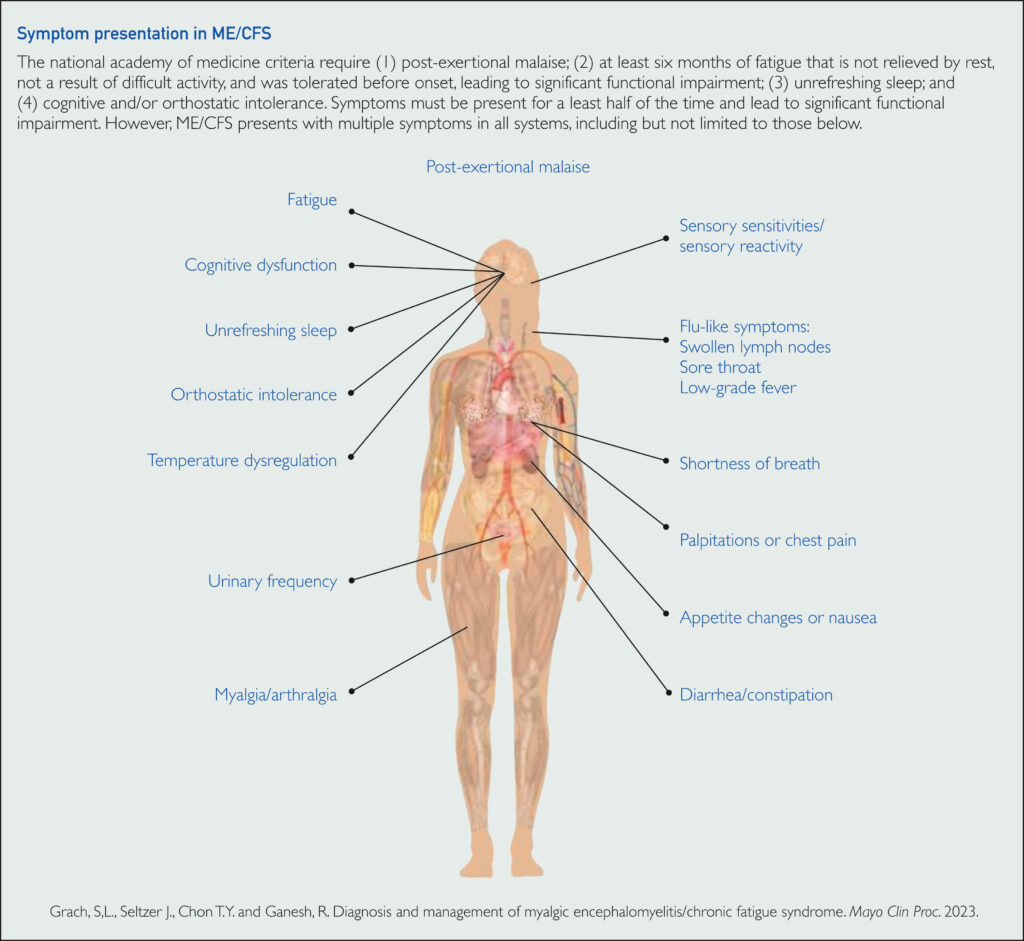
Extract – Figure 1 shows how and where ME/CFS symptoms affect patients
Extract – Table: Management considerations for ME/CFS based on symptoms.
| Symptom | Management considerations |
|---|---|
| Post-exertional malaise | Pacing/rest, stimulus reduction, tracking devices or diaries for symptoms |
| Fatigue | Pacing, low-dose naltrexone, low-dose aripiprazole, anti-inflammatory diets, supplements, vitamin deficiency treatment |
| Sleep issues | Melatonin, trazodone, suvorexant, doxepin/tricyclic antidepressants, gabapentin/pregabalin |
| Cognitive dysfunction | Journaling, memory aids, occupational therapy, low-dose naltrexone, low-dose aripiprazole, careful use of stimulants |
| Orthostatic intolerance | Fluids/electrolytes/compression, fludrocortisone, midodrine, propranolol, pyridostigmine, guanfacine (best guided by postural orthostatic tachycardia syndrome subtype or tilt vital signs) |
| Dizziness (frequent) | Consider persistent postural-perceptual dizziness diagnosis, vestibular therapy, low-dose selective serotonin reuptake inhibitor or serotonin-norepinephrine reuptake inhibitor |
| Muscle or joint pain | Over-the-counter medications, duloxetine, milnacipran, pregabalin, gabapentin, tricyclic antidepressants, low-dose naltrexone |
| Neuropathy | Pregabalin, gabapentin, tricyclic antidepressants, compression or brace therapy |
| Sensory amplification | Noise-canceling headphones, tinted glasses, crowd exposure reduction, low-dose aripiprazole |
| Gastrointestinal symptoms | Anti-inflammatory diets, small meals, pro/synbiotics, antidiarrheals or antihistamines for diarrhea, fiber or motility agents for constipation |
You can read the full article here: Diagnosis and Management of Myalgic Encephalomyelitis/Chronic Fatigue Syndrome