| |

Petition – Build your response to the government’s consultation on benefits – Sense

Note: Content below copied from action.sense.org.uk

https://action.sense.org.uk/page/169317

The government is proposing making changes to the benefits system. This tool helps you write a response to their consultation. It is designed for disabled people and their families. 

The government’s changes are complicated, so we’ve broken things down into four main proposals. Here’s how it works:

  1. We’ll ask a question or two about each proposal and suggest some things to think about in your answer. You don’t have to respond to every question.
  2. We’ll compile all your answers into one response.
  3. Copy this response into an email to send to the Department of Work and Pensions.

This should take about 20 minutes to complete. While that might seem like a lot of time, it’s much more effective to take the time to write a consultation response that is tailored to you.

Continue to complete the form here: https://action.sense.org.uk/page/169317

Similar Posts

  • #ThereForME Launches “Fund The Plan” Appeal

    Today, #ThereForME launched a campaign to strike back at the Government asking them to #FundThePlan.

    People with ME were invited to produce a short video appealing to Wes Streeting (Secretary of State for Health ) and Ashley Dalton (recently appointed Under-Secretary of State / Department of Health and Social Care)to allocate new funding to the long awaited UK Delivery Plan for ME

    Read More “#ThereForME Launches “Fund The Plan” Appeal”
  • |

    ‘You don’t want to get better’: the outdated treatment of ME/CFS patients is a national scandal

    This article, published in March 2024 by George Monbiot analyses how medical gaslighting has stopped progress from being made to support people with the debilitating condition of ME/CFS


    Powered by Guardian.co.ukThis article titled “‘You don’t want to get better’: the outdated treatment of ME/CFS patients is a national scandal” was written by George Monbiot, for The Guardian on Tuesday 12th March 2024 08.00 UTC

    It’s the greatest medical scandal of the 21st century. For decades, patients with ME/CFS (myalgic encephalomyelitis/chronic fatigue syndrome) have been told they can make themselves better by changing their attitudes. This devastating condition, which afflicts about 250,000 people in the UK, was psychologised by many doctors and scientists, adding to the burden of a terrible physiological illness.

    Long after this approach was debunked in scientific literature, clinicians who championed it have refused to let go. They continue to influence healthcare systems, governments and health insurers. And patients still suffer as a result.

    ME/CFS saps sufferers of energy and basic physical and cognitive functions, confining many to their homes or even their beds, often shutting down their working lives, social lives and family lives. The extreme seriousness of this condition, and the fact that there is neither a diagnostic test nor a validated treatment, places a special duty of rigour on doctors and researchers. But patient care has been compromised, and useful research inhibited, by the lingering conviction of many practitioners that ME/CFS is “psychosocial”: driven by patients’ beliefs and behaviour.

    This was a story that found me. In 2021, after writing about long Covid, I was accused by the psychiatrist Prof Michael Sharpe of spreading it. Apparently, you could induce such illnesses by discussing them. Investigating further, I was astonished by the failure in his presentation to support his claim with evidence, and perturbed by his lack of satisfactory answers to my questions. Sharpe takes a similarly “biopsychosocial” approach to ME/CFS, one which at the time of his long Covid presentation still dominated medical practice in the UK.

    You can trace the origins of this model to a paper published in 1970. Without assessing a single patient or interviewing a single doctor, it blamed an earlier outbreak of post-viral ME/CFS on “mass hysteria” based on case notes alone. The reasoning included the fact that the outbreak affected more women than men. For centuries, doctors have been readier to classify women’s illnesses as hysterical or psychosomatic than they have men’s. ME/CFS, like long Covid, hits women harder, so, the thinking goes, it must be all in the mind.

    Freedom of information requests to the National Archives show how the biopsychosocial model became embedded in research practice and government policy. The minutes of a meeting on government benefits policy in 1993 give a sense of the position of the psychiatrist Simon Wessely at the time. As summarised in the minutes, he told the meeting that ME/CFS is “not a neurological disorder”. He reportedly claimed that apparently severe cases were likely to result from either a “misdiagnosed psychiatric disorder or poor illness management”, while many cases were “iatrogenic”: caused by medical examination or treatment. His views were apparently that “the worst thing to do is to tell them to rest”, “exercise is good for these patients”, “most cases can be expected to improve with time” and, perhaps most shockingly, “benefits can often make patients worse”.

    Every one of these claims now appears to be without foundation. But they became the basis of the dominant approach in this country to attempting to treat ME/CFS. The toll of patient suffering is hard to imagine.

    In 2007 this belief system became official guidance: the National Institute for Health and Care Excellence (Nice) advocated two treatments arising from the biopsychosocial model of the disease: graded exercise therapy (GET) and cognitive behavioural therapy (CBT). In 2011, a major study, the Pace trial, part-funded by the Department for Work and Pensions, claimed to show that GET and CBT were effective in treating ME/CFS. The study later turned out to be biased and profoundly flawed.

    The believers were championed by the Science Media Centre, of which (now Professor Sir) Simon Wessely was a founder member. Some of the media’s reporting, influenced by the centre, portrayed ME/CFS patients as abusive, threatening, workshy and resistant to treatment.

    As the doctrine spread through the medical profession, some practitioners adopted the same attitudes. A paper promoting psychological treatments lamented the “difficult challenge of … managing patients’ resistance to the treatment”, which arose from “lack of acceptance as to the rationale”. Nurses observed that “the patient should be grateful and follow your advice [but] the patient is quite resistant and there is this thing like you know, ‘The bastards don’t want to get better’.”

    We now know that patients were right to resist interventions that have proved to be both useless and harmful. The impacts were often horrific. A study in Switzerland found that the most powerful factor contributing to suicidal thoughts among people with ME/CFS was “being told the disease was only psychosomatic”.

    Some patients were forced into these treatment regimes, even locked in psychiatric units to make them comply. Some parents of children with ME/CFS were referred to social services for supposedly encouraging their belief that they were ill. Though unevidenced, the biopsychosocial model influenced the government’s social security policy, reinforcing its coercive treatment of people seeking disability benefits.

    In 2020, an independent review by Nice found that the quality of all the research promoting GET and CBT was either “low” or – mostly – “very low”. A paper reported that the thresholds in the 2011 Pace study at which patients were deemed to have recovered had been altered after the trial began. Several studies concluded that GET was actively harmful , as the exercise regime it promoted could worsen patients’ symptoms, causing post-exertional malaise. One paper reported that it was detrimental to the health of at least 50% of patients.

    As a result, in 2021 Nice concluded that GET and CBT should not be used to treat ME/CFS (though more conventional CBT can help patients with the psychological impacts of the illness). Similar shifts had already happened in the United States and the Netherlands. The condition is now correctly recognised as a physiological illness. Last month, a paper in the journal Nature Communications proposed a possible physiological mechanism for the condition.

    But some people never give up. Despite an overwhelming weight of evidence, the old believers, including Sharpe and Wessely, have continued to try to justify their model, obliging Nice recently to publish a strong refutation. Protected by powerful friends in the media, they could breathe life into their hypothesis long after it had been debunked. The new evidence-led thinking has yet to penetrate parts of the health system: some patients are still being mistreated.

    This is not how science should work. Beliefs should be based on evidence. In medicine, there is a double duty: respect the evidence and listen to patients. There is a psychological intervention that could improve the lives of people with ME/CFS: an apology and recognition of the harms they have suffered.

    • George Monbiot is a Guardian columnist

    • Join George Monbiot for a Guardian Live online event on Wednesday 8 May 2024 at 8pm BST. He will be talking about his new book, The Invisible Doctrine: The Secret History of Neoliberalism. Book tickets here

    • Do you have an opinion on the issues raised in this article? If you would like to submit a response of up to 300 words by email to be considered for publication in our letters section, please click here.

    • This article was amended on 12 March 2024 to replace an incorrect hyperlink.

    guardian.co.uk © Guardian News & Media Limited 2010

    Published via the Guardian News Feed plugin for WordPress.

  • | |

    Petition – Stop Proposed Changes to PIP -Organise

    Note: Content below copied from Organise.network

    https://organise.network/actions/petition-stop-proposed-changes-to-pip-zqTA0zIpHYQ/saf/take-action

    We urge the Government to:

    Cease any changes to PIP eligibility that would reduce access for those in genuine need. Maintain inflation-linked increases to ensure PIP keeps pace with the cost of living. Conduct a transparent and meaningful consultation with disabled people and advocacy groups before implementing any reforms. 

    We stand against policies that put financial strain on disabled individuals and demand fair, compassionate, and well-evidenced reform.

    Sign this petition to protect the rights and support of disabled people in the UK.

  • |

    Justice For ME Campaign Launched

    Please share – A very important campaign was launched on the evening of 29th August 2025 to help provide legal support for targeting improvements in medical care, thereby benefiting everyone with ME or Long Covid induced illness.

    “Campaigning for ME (Myalgic Encephalomyelitis) to be medically managed safely, to protect families from permanent disability or death from neglect of the illness”

    Find history, campaign details information and endorsements available on on the Crowd Justice site via the following link: justice4me.uk

    Update 31/08/2025 – On a public facing Facebook comment, where some were discussing the nature of the campaign and potential legal cases, in answer to a question raised by an ME patient, Sarah Boothby (one of the endorsers of the campaign and mother of Maeve Boothby O’Neill, who tragically died from ME in October 2021 aged only 27) shared her understanding of what she believes #JusticeForME is intending (my bold, for emphasis, below):

    “It is a case against the government, for neglecting to deliver a specialist health service in its Final Delivery Plan for ME/cfs.

    Without Consultant led NHS specialist services everyone with #ME in England is denied access to the disability rights other medical conditions are given as granted and, if/when they need hospital treatment, no provision is made for the specialist nursing care demanded by the nature of the illness (hypersensitivies to all sensory stimuli that increase with #PEM). This automatically triggers the worst PEM ever – adding years of the most horrible symptoms to an already horrible illness. The campaign is to stop this neglect.”

    As of this evening (31/08/2025), the campaign has astonishingly already received over £5,000 in pledges of first target of £6,000 within 48 hours of launch, with 28 days still remaining.

    Full details and donations via the link here, taking you to Crowd Justice: justice4me.uk

  • #ThereForME publishes first UK Ecosystem report for ME and Long Covid

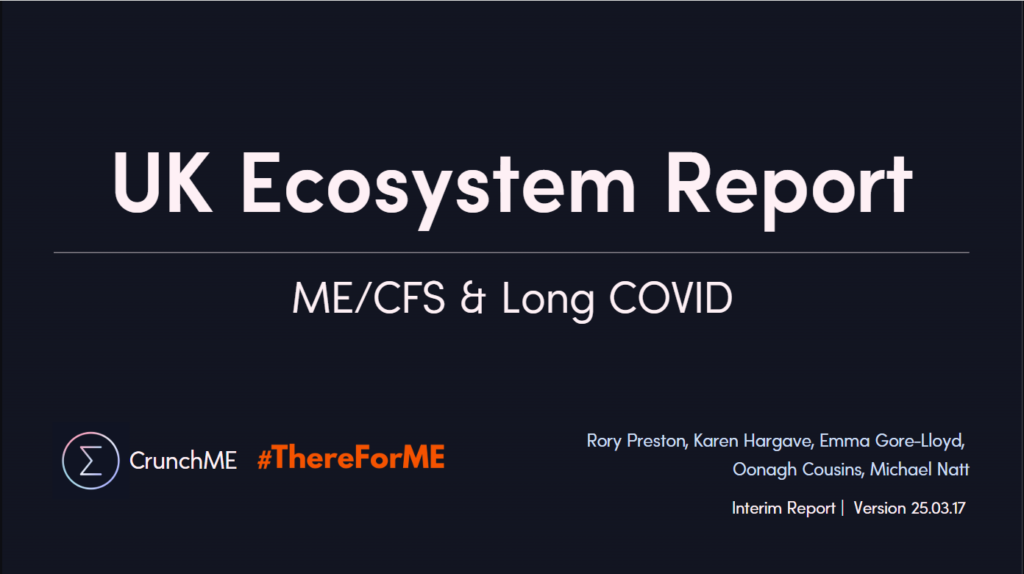
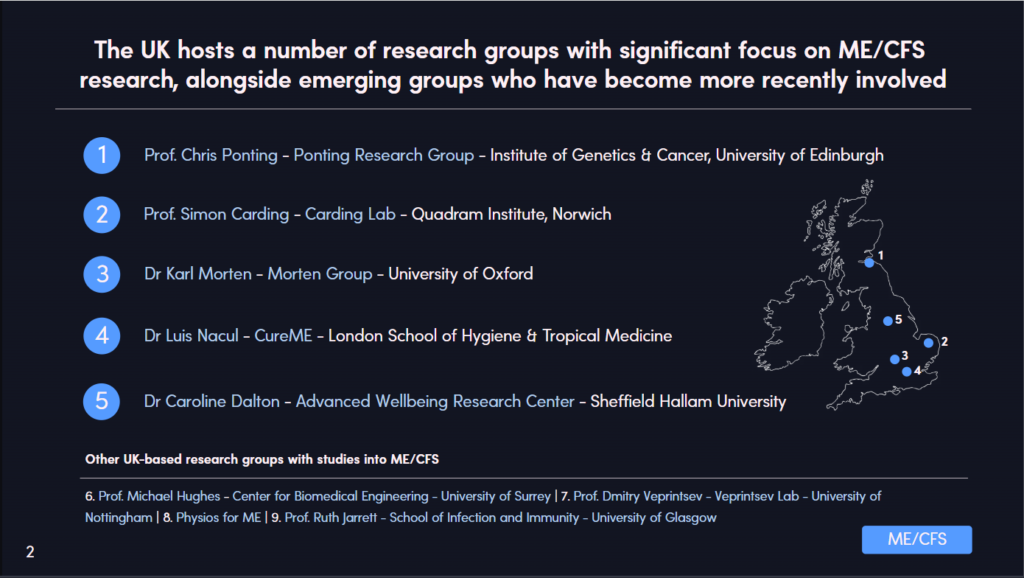
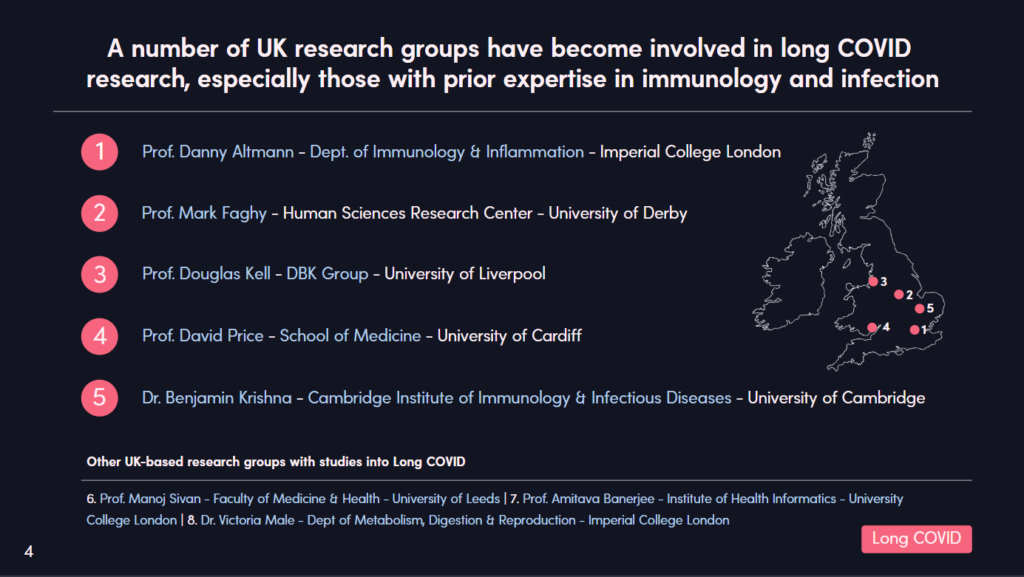
    The #ThereForME team have published the first version of their UK Ecosystem Report for ME and Long Covid, created in collaboration with CrunchME. This report maps out key stakeholders and initiatives across the UK, aiming to inform advocacy efforts, policymakers, and potential funders of research and care.

    The report tracks active and future ME/CFS research projects within the UK. Following each overview slide like the one below, are detailed additional slides showing the technical nature of the work and interventions being trialled.

    Following slides go in to show research projects for Long Covid within the UK, Clinics and Clinicians, Biotech resource, and forthcoming conferences.

    The full UK ecosystem report for ME and Long Covid can be found here

    Everything about the #TherForME campaign can be found on the TherForME website

  • A personal Email from me to Munira Wilson about Benefits cuts

    Email sent on: 24/03/2025 20:23

    Dear Munira,

    I am writing to express my deep concern regarding the recently proposed cuts to disability benefits, which are expected to reduce the benefits bill by £5 billion by the end of the decade. As someone affected by Myalgic Encephalomyelitis/Chronic Fatigue Syndrome (ME/CFS), I fear these changes will have a significantly detrimental impact on people like me, who rely on this support.

    The proposed tightening of eligibility criteria, especially now rejecting summation of different incapacities for Personal Independence Payments (PIP) means that only the most severely disabled will qualify, potentially leaving up to 1.2 million people without essential support. This is particularly concerning for those with ME/CFS, a broadly debilitating neurological condition affecting at least 250,000 people in the UK. Many have developed ME/CFS following COVID-19, further increasing the number of individuals requiring assistance.

    Below is an illustration (adapted, please see note below) showing the unfairness of the new points scoring system proposed, where combinations of incapacities would not be considered equivalent e.g. to the proposed score of four or more in one specific incapacity:

    PIP Eligible vs PIP Ineligible

    The reduction in benefits not only threatens the financial stability of disabled individuals but also risks increasing strain on local councils and the NHS. As people lose access to PIP, they may be forced to rely more heavily on council-funded care services, overwhelming already limited resources and leading to increased administrative and emergency service costs.

    I urge you to consider the following actions:

    1. Oppose the proposed cuts to disability benefits: Recognize the long-term consequences these reductions will have on disabled individuals and the broader community, and advocate for policies that protect the most vulnerable.
    1. Continue your support All-Party Parliamentary Group (APPG) on ME: Your participation is already helping to ensure that the voices of those with ME/CFS are heard and that their unique challenges are addressed in policy discussions.
    1. Advocate for the implementation of the 2021 NICE guidelines and the forthcoming Department of Health and Social Care (DHSC) Delivery Plan for ME/CFS: These documents provide comprehensive recommendations for the diagnosis, management, and support of individuals with ME/CFS.

    I would be grateful for the opportunity to discuss these concerns further personally and to hear your stance on this critical issue.

    I would like to request a face-to-face meeting at one of your Twickenham surgeries in the near future please, if not perhaps a Zoom or a telephone call.  Please let me know if and when this would be possible.

    Thank you in advance for your attention to this matter.

    Yours sincerely,

    Steve

    Note: Image included above adapted from (totally unrelated) Neurodiversity article by “Teaching Times Group”

Leave a Reply