| |

Diagnosis and Management of Myalgic Encephalomyelitis/Chronic Fatigue Syndrome

Extracts from full Mayo Clinic Article Originally published in October 2023. Selected text and images only included below see full article link at end of page

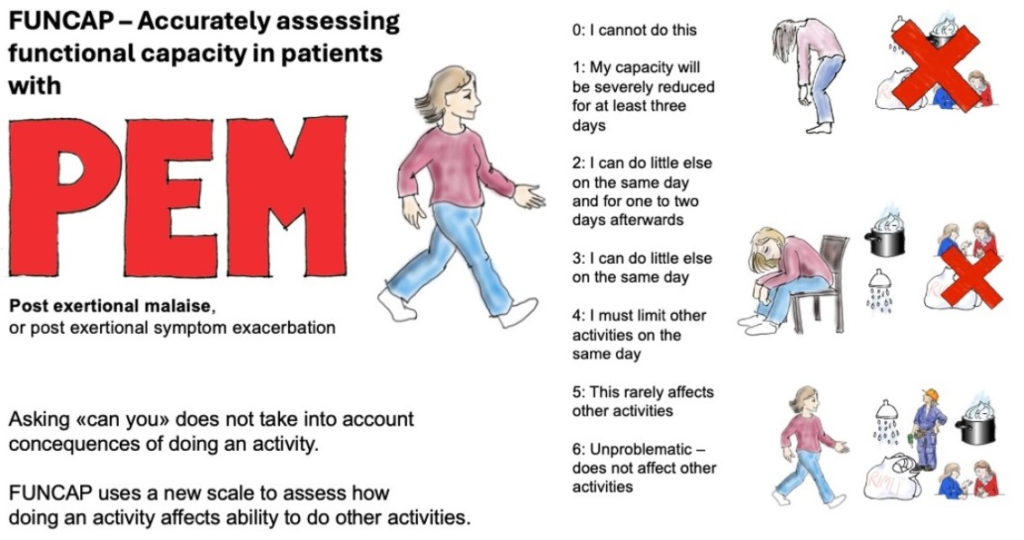
Extract – Figure 2 shows typical PEM presentations

Publication / Authors

Concise review for clinicians Volume 98, Issue 10, p1544-1551, October 2023: Stephanie L. Grach, MD, Jaime Seltzer, MS, Tony Y. Chon, MD, Ravindra Ganesh, MD, MBBS

Extract – Abstract

Myalgic encephalomyelitis/chronic fatigue syndrome (ME/CFS) is a chronic neurologic disease
often preceded by infection. There has been increased interest in ME/CFS recently
because of its significant overlap with the post-COVID syndrome (long COVID or post-acute
sequelae of COVID), with several studies estimating that half of patients with post-COVID
syndrome fulfill ME/CFS criteria. Our concise review describes a generalist approach to
ME/CFS, including diagnosis, evaluation, and management strategies.
(c) 2023 THE AUTHORS. Published by Elsevier Inc on behalf of Mayo Foundation for Medical Education and Research. This is an open access article under the CC BY-NC-ND license (http://creativecommons.org/licenses/by-nc-nd/4.0/) n Mayo Clin Proc. 2023;98(10):1544-1551

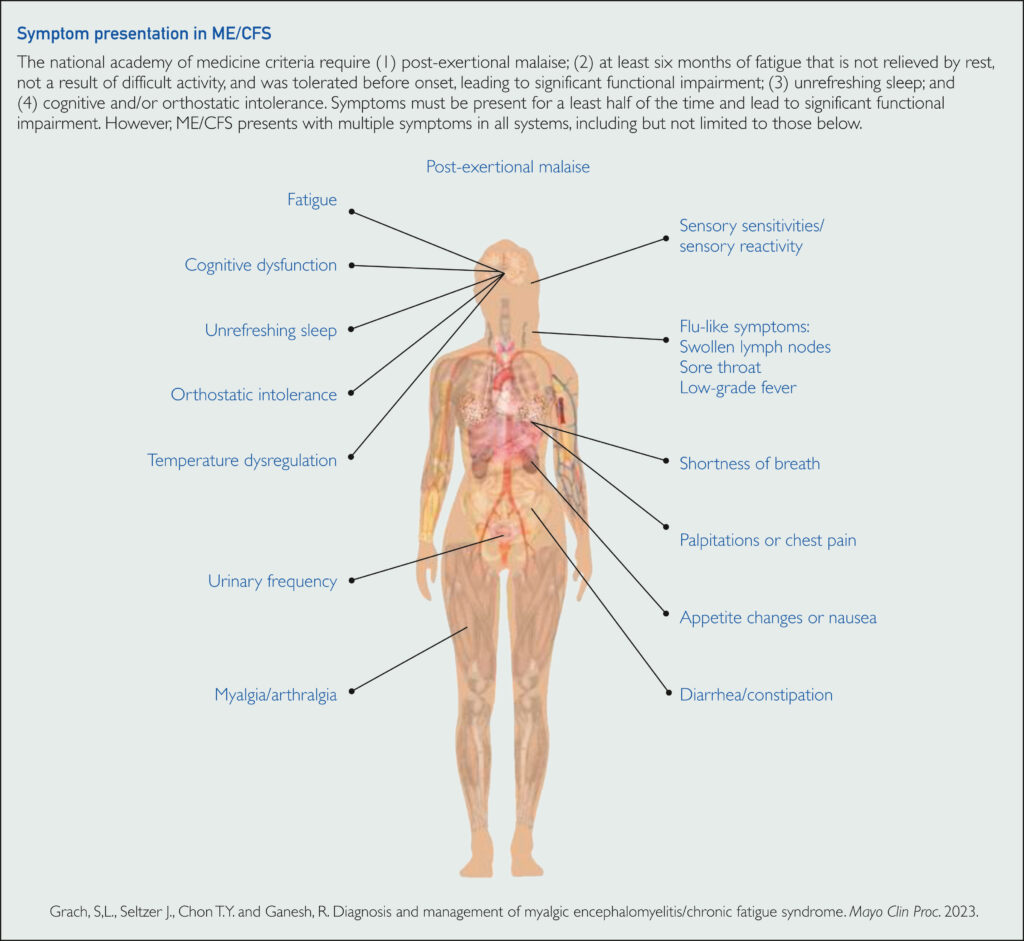
Extract – Figure 1 shows how and where ME/CFS symptoms affect patients
Extract – Table: Management considerations for ME/CFS based on symptoms.

SymptomManagement considerations
Post-exertional malaisePacing/rest, stimulus reduction, tracking devices or diaries for symptoms
FatiguePacing, low-dose naltrexone, low-dose aripiprazole, anti-inflammatory diets, supplements, vitamin deficiency treatment
Sleep issuesMelatonin, trazodone, suvorexant, doxepin/tricyclic antidepressants, gabapentin/pregabalin
Cognitive dysfunctionJournaling, memory aids, occupational therapy, low-dose naltrexone, low-dose aripiprazole, careful use of stimulants
Orthostatic intoleranceFluids/electrolytes/compression, fludrocortisone, midodrine, propranolol, pyridostigmine, guanfacine (best guided by postural orthostatic tachycardia syndrome subtype or tilt vital signs)
Dizziness (frequent)Consider persistent postural-perceptual dizziness diagnosis, vestibular therapy, low-dose selective serotonin reuptake inhibitor or serotonin-norepinephrine reuptake inhibitor
Muscle or joint painOver-the-counter medications, duloxetine, milnacipran, pregabalin, gabapentin, tricyclic antidepressants, low-dose naltrexone
NeuropathyPregabalin, gabapentin, tricyclic antidepressants, compression or brace therapy
Sensory amplificationNoise-canceling headphones, tinted glasses, crowd exposure reduction, low-dose aripiprazole
Gastrointestinal symptomsAnti-inflammatory diets, small meals, pro/synbiotics, antidiarrheals or antihistamines for diarrhea, fiber or motility agents for constipation

You can read the full article here: Diagnosis and Management of Myalgic Encephalomyelitis/Chronic Fatigue Syndrome
Similar Posts

  • | | |

    Professor Deepa Mann-Kler Director & Producer – Introduces the Discover M.E. Film

    Professor Deepa Mann-Kler Director & Producer introduces an award winning 6-minute, animated video that shares the voices of, and the insights into, the lives of 6 people living with Myalgic Encephalomyelitis in Northern Ireland. It places the viewer into real life scenarios that are normally never seen, heard or experienced. This narrows the gap between an individual’s preconceived beliefs and real personal experience. It can be viewed via a 3D, virtual reality headset for maximum experience (directly arranged by contacting the Charity), or as a normal 2D video via this YouTube link.

    Produced between Hope 4 ME & Fibro Northern Ireland, Silverink, and Neon. To date, it has won 4 international short film awards.

    Discover M.E. Film (no Introduction)

    To just watch the video without the introduction, please click below:

  • |

    Justice For ME Campaign Launched

    Please share – A very important campaign was launched on the evening of 29th August 2025 to help provide legal support for targeting improvements in medical care, thereby benefiting everyone with ME or Long Covid induced illness.

    “Campaigning for ME (Myalgic Encephalomyelitis) to be medically managed safely, to protect families from permanent disability or death from neglect of the illness”

    Find history, campaign details information and endorsements available on on the Crowd Justice site via the following link: justice4me.uk

    Update 31/08/2025 – On a public facing Facebook comment, where some were discussing the nature of the campaign and potential legal cases, in answer to a question raised by an ME patient, Sarah Boothby (one of the endorsers of the campaign and mother of Maeve Boothby O’Neill, who tragically died from ME in October 2021 aged only 27) shared her understanding of what she believes #JusticeForME is intending (my bold, for emphasis, below):

    “It is a case against the government, for neglecting to deliver a specialist health service in its Final Delivery Plan for ME/cfs.

    Without Consultant led NHS specialist services everyone with #ME in England is denied access to the disability rights other medical conditions are given as granted and, if/when they need hospital treatment, no provision is made for the specialist nursing care demanded by the nature of the illness (hypersensitivies to all sensory stimuli that increase with #PEM). This automatically triggers the worst PEM ever – adding years of the most horrible symptoms to an already horrible illness. The campaign is to stop this neglect.”

    As of this evening (31/08/2025), the campaign has astonishingly already received over £5,000 in pledges of first target of £6,000 within 48 hours of launch, with 28 days still remaining.

    Full details and donations via the link here, taking you to Crowd Justice: justice4me.uk

  • Large hippocampus detected in Long COVID and ME/CFS patients

    This study compared alterations in hippocampal subfields of 17 long COVID, 29 ME/CFS patients, and 15 healthy controls (HC), identifying significantly larger volumes in the left hippocampal subfields of both long COVID and ME/CFS patients compared to Healthy Controls.

    Abstract

    Long COVID and Myalgic Encephalomyelitis/Chronic Fatigue Syndrome (ME/CFS) patients share similar symptoms including post-exertional malaise, neurocognitive impairment, and memory loss. The neurocognitive impairment in both conditions might be linked to alterations in the hippocampal subfields. Therefore, this study compared alterations in hippocampal subfields of 17 long COVID, 29 ME/CFS patients, and 15 healthy controls (HC).

    Read More “Large hippocampus detected in Long COVID and ME/CFS patients”
  • Hidden Illness, Public Grief, and Research Funding: Why ME/CFS and Other Gradual-Onset Conditions Struggle for Recognition

    Author: Steve Fifield 3rd March 2026

    I wrote a simple draft paper on possible reasons why ME/CFS and similar conditions struggle so much for public recognition and funding.

    Executive Summary

    This briefing paper proposes that illnesses characterised by gradual onset, symptom invisibility, and ambiguous loss—such as Myalgic Encephalomyelitis/Chronic Fatigue Syndrome (ME/CFS)—face structural disadvantages in public recognition and research funding.

    In contrast to diseases associated with sudden, catastrophic diagnoses (e.g., cancer, motor neurone disease, multiple sclerosis), ME/CFS often progresses gradually, without a singular crisis moment that mobilises families, media, and policymakers.

    Drawing on psychological research, communication theory, medical sociology, and health policy analysis, this paper outlines evidence supporting the hypothesis that acute grief catalyses mobilisation, while chronic ambiguity fosters adaptation rather than advocacy.

    1. Proposition Statement

    Public support for disease research funding is strongly influenced by emotional salience, narrative clarity, and visibility.

    • This paper proposes that:
    • Sudden, high-intensity diagnoses generate collective grief and advocacy mobilisation.
    • Gradual, invisible illness trajectories tend to produce adaptation and normalisation rather than public outrage.
    • Conditions lacking clear biomarkers or dramatic ‘trigger events’ may remain socially marginalised and underfunded.

    2. Psychological Evidence: Emotion, Grief, and Giving

    Research in behavioural psychology demonstrates that emotional intensity significantly influences charitable giving and advocacy behaviour.

    • Key evidence includes:
    • The ‘Identifiable Victim Effect’ shows individuals donate more readily when harm is concrete and personal (Small & Loewenstein, 2003).
    • Personal experience with illness strongly predicts sustained advocacy engagement (Bekkers & Wiepking, 2011).
    • Acute grief produces action-oriented coping responses, whereas ambiguous loss can lead to prolonged emotional adjustment rather than mobilisation (Boss, 1999).

    3. Media Visibility and Agenda Setting

    Agenda-setting research demonstrates that media coverage shapes public perceptions of issue importance (McCombs & Shaw, 1972).

    • Relevant dynamics:
    • Diseases with dramatic diagnostic narratives are more likely to receive concentrated media attention.
    • High-visibility campaigns (e.g., viral fundraising movements) significantly increase funding inflows.
    • Invisible or contested illnesses struggle to achieve sustained media framing as urgent biomedical crises.

    4. Medical Sociology: Invisible and Contested Illness

    ME/CFS has historically been classified as a contested or medically unexplained illness.

    • Sociological findings show:
    • Illnesses lacking objective biomarkers often face legitimacy challenges (Barker, 2008).
    • Symptom invisibility contributes to stigma and disbelief (Dickson et al., 2007).
    • Gradual functional decline may be socially normalised within families, reducing collective mobilisation.

    5. Research Funding and Disease Burden

    Multiple analyses indicate that biomedical research funding does not consistently align with disease burden.

    • Findings relevant to ME/CFS:
    • Funding levels for ME/CFS have historically been substantially lower than expected based on disability-adjusted life years (DALYs) (Dimmock et al., 2016).
    • Mortality salience and media visibility correlate more strongly with funding allocation than chronic disability alone.
    • Conditions perceived as life-threatening often secure greater political and philanthropic urgency.

    6. Policy and Strategic Implications

    If this proposition is valid, important implications follow for research institutions, advocacy organisations, and policymakers.

    • Potential strategies:
    • Develop narrative frameworks that communicate cumulative functional loss without sensationalism.
    • Align funding mechanisms more closely with disease burden metrics rather than media salience.
    • Invest in biomarker research to strengthen clinical legitimacy.
    • Promote public education campaigns that clarify the biological basis and severity of ME/CFS.

    Conclusion

    ME/CFS exemplifies how gradual-onset, invisible illnesses may be structurally disadvantaged within public funding ecosystems shaped by emotion, visibility, and narrative shock.

    Addressing this imbalance requires deliberate policy design, improved public communication, and recognition that chronic disability without dramatic rupture can be equally life-altering.

    Selected References

    1. Barker, K. (2008). Electronic support groups, patient-consumers, and medicalization.
    2. Bekkers, R., & Wiepking, P. (2011). A literature review of empirical studies of philanthropy.
    3. Boss, P. (1999). Ambiguous Loss: Learning to Live with Unresolved Grief.
    4. Dickson, A., et al. (2007). Stigma in chronic fatigue syndrome.
    5. Dimmock, M., et al. (2016). Estimating the disease burden of ME/CFS in the United States.
    6. McCombs, M., & Shaw, D. (1972). The agenda-setting function of mass media.
    7. Small, D., & Loewenstein, G. (2003). Helping a victim or helping the victim: Identifiable victim effect.

Leave a Reply