|

Vagus Nerve Stimulation – Nurosym, Gammacore, Pulsetto and Sensate reviewed and compared

A comprehensive overview of four VNS devices (though one doesn’t actually perform Vagus Nerve stimulation at all) by Health Scientific Institute.

These devices have become popular, but they can also be very expensive, once monthly subscriptions are considered.

People with ME and Long Covid should also take care to choose a device with a variable stimulation level, else stimulation given can cause unwanted side effects or unexpected increase of symptoms.

Similar Posts

  • | |

    Preprint – Smartphone-based monitoring of heart rate variability and resting heart rate predicts variability in symptom exacerbations in people with complex chronic illness

    Annie Aitken1; Abbey Sawyer; Akiko Iwasaki; Harlan M. Krumholz; Rory Preston; Harry Leeming; Jenna Tosto-Mancuso; Amy Proal; Michael A. Osborne; David Putrino

    Version 1 posted 29 Nov, 2024

    Abstract

    Background: Complex chronic conditions like Long COVID and Myalgic Encephalomyelitis/Chronic Fatigue Syndrome involve energy limitations and changes in heart rate variability (HRV) and resting heart rate (HR). Mobile health technologies now offer real-time, valid measurements of HRV and HR, advancing symptom monitoring and management. Using a high-density dataset from an observational longitudinal study, we aimed to describe, quantify, and predict within-person co-variations in daily biometric data and subsequent crash, fatigue, and brain fog symptom occurrences.

    Methods: Leveraging data collected through a mobile health app (n=4,244), we developed predictive models using mixed-effects linear regression and logistic regression to explore how within-person fluctuations in biometrics (HR, HRV, and respiratory rate) predict dynamic change in symptomology (crash, fatigue, and brain fog). Predictive performance was assessed using 5-fold stratified cross-validation and compared to a 20% holdout set to evaluate model generalizability to new observations and individuals.

    Results: Across all symptom domains, within-person changes in HRV and HR consistently emerged as key predictors of symptom change across all models, with higher HR and lower HRV conferring risk for crashes, fatigue, and brain fog. Moreover, 7-day biometric stability (or variable dispersion) was a robust predictor of symptom occurrence and severity. Models trained solely on biometric features achieved moderate predictive performance in the stratified cross-validation set; however, incorporating random effects to capture individual-specific variations and prior-day symptom reports substantially enhanced model accuracy, with AUC values reaching .91.

    Discussion and Conclusion: This study is the first to use data-driven models to predict everyday symptom experiences in individuals with complex chronic illnesses based on biometric fluctuations. Findings demonstrate the potential utility of mobile health tools for real-time monitoring of symptoms and highlight the need for further research to refine these predictive models and integrate them into clinical decision-making processes.

    Read the full preprint article here: https://www.researchsquare.com/article/rs-5423422/v1

  • | | | |

    Bateman Horne Clinical Care Guide for ME/CFS, Long COVID & Infection-Associated Chronic Conditions

    Released as version 1.0 today, a new and outstandingly comprehensive reference guide for both Doctors and Health Care Workers. The reference guide we needed 20 years ago! This certainly feels like an essential training reference:

    “A Roadmap to Better Care:
    Clinical Care Guide for ME/CFS, Long COVID &
    Infection-Associated Chronic Conditions

    Developed by the OMF-supported Medical Education Resource Center (MERC) at Bateman Horne Center, this resource offers a practical path forward—one grounded in clinical expertise, research, and the lived experience of patients”

    https://batemanhornecenter.org/clinical_roadmap

    Direct link to download the guide PDF

  • |

    Today in Focus – Living with Long Covid when the world has moved on

    Helen Pidd discusses what life is like during and after Long Covid. Emma Gore-Lloyd shares her continuing journey in search of a cure for her partner James, whilst Georgina tells her story of how she got better.

    Podcast from the Guardian article: https://www.theguardian.com/news/audio/2025/mar/25/inside-the-mystery-of-long-covid-recovery-podcast

    You can also listen directly below:

    YouTube links are provided here when available as well as Spotify, as they don’t currently require a subscription to watch / listen. Listening via Spotify makes it easier to listen whilst doing something else on your browser or phone.

  • |

    Disabled, Discharged and Disappearing from View

    By Long Covid Support and Long Covid Kids

    Vital Long Covid Clinics Closing Across the UK Despite Ongoing Need, New Research Warns

    A study by Long Covid Support and Long Covid Kids has unveiled alarming gaps in Long Covid care, revealing that numerous specialist services across the UK are either shutting down or facing imminent closure. Despite NHS England confirming funding for Long Covid services through 2025/26, Freedom of Information (FOI) requests and direct communications with service providers indicate that many are already closing or operating under uncertainty.

    This report explores the experiences of people with Long Covid in the UK in using NHS services. It views these experiences within the context of uncertainty around the future funding model from NHS England and the fragmented approaches to Long Covid care in the devolved nations. We use information from
    a number of sources to challenge the view that it is appropriate to
    de-prioritise specialist Long Covid services in the UK.

    Who this report is for
    This report is intended for policymakers and government departments, including Department for Health and Social Care (DHSC), Department for Work and Pensions (DWP), Department for Education (DfE), the Health Select Committee, health secretaries, and the All-Party Parliamentary Group (APPG) on Long Covid.
    It is also relevant to National Health
    Service (NHS) health authorities such as NHS England, individual healthcare boards in

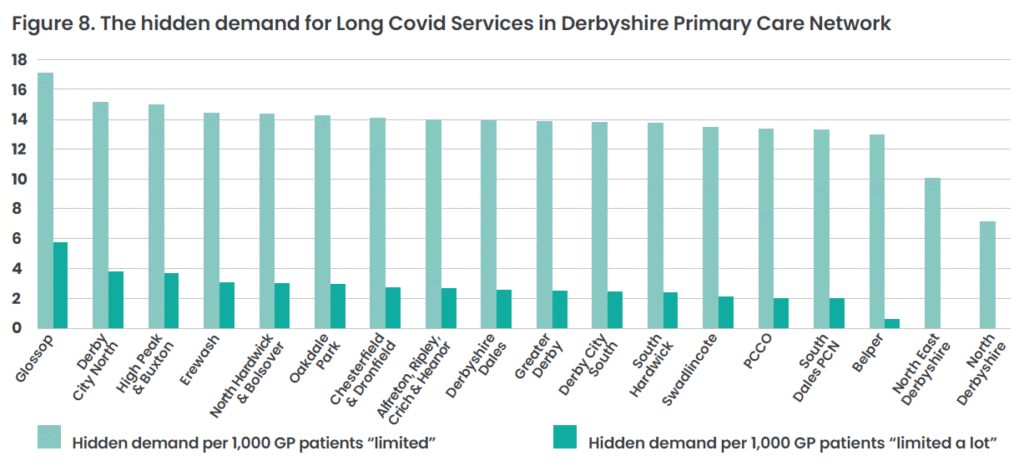
    This is a long read, but you have everything here. The “Hidden demand” figure on page 47 says for the Derbyshire case study shows that less demand for services isn’t the reason the services are closing down.

    View the full report online here:

    Disabled, Discharged and Disappearing from View

    The slides presented online are now included below:

    The slide pack is also available here

  • | | | | |

    #Justice4ME Campaign Update No. 3

    Quote from Sarah Boothby on Social Media

    We have now taken legal advice, thanks to your donations, and instructed our lawyers to proceed with sending a letter before claim to the Department of Health and Social Care (DHSC).  This does not mean there will be a claim (an application to the court for Judicial Review of the Final Delivery Plan for ME/cfs) it means there are inconsistencies within the Plan that make it vulnerable to legal challenge.

    We doubt this vulnerability is what was intended in the drafting of the Plan.  We know people with ME/cfs have had cross party political support for decades.  We know hundreds of people contributed their knowledge, lived experience and expertise to developing the Plan, so we hope these snags will be resolved without a court hearing being necessary.  People living with ME, and the NHS staff trying their best to deliver safe clinical care without clear, succinct, safe clinical guidance to follow, deserve nothing less.

    If the reply from DHSC to our letter is not satisfactory, and the inconsistencies we have identified in the Final Delivery Plan persist, we must apply for Judical Review by 21 October at the latest.

    At this stage, we cannot share with you the advice we have been given but we will explain everything the very first chance we get.  Sorry if that’s frustrating; it is for us!  If the case does come to court the legal arguments will be made public that way but we hope the DHSC will make the changes needed sooner.  The changes needed are not huge, they are efficient, and they will not cost the NHS more money than is already being wasted on catastrophic mismanagement of ME.

    This is a first step, made possible only by your generosity and the long history of injustice that got us here.  We are honoroued by so many of you sharing your time, comments and money with us.  We could not have got so far without you.  We rely on your feedback on social media to be sure the aims of #Justice4ME reach the widest audience possible.

    More updates will follow in the coming weeks, including additional endorsements and images on our homepage.  Meanwhile, please keep on sharing our campaign with everyone you know, however unlikely!  Since we met the initial fundraising target in our launch week, the campaign to raise the final third for this first phase will continue throughout October.

    Thank you, thank you, thank you for helping make #Justice4ME a serious proposition. Let’s have our NHS knowing what to do about ME without doubts, indecision or delays – all over the UK, please.

    #JusticeforME

Leave a Reply