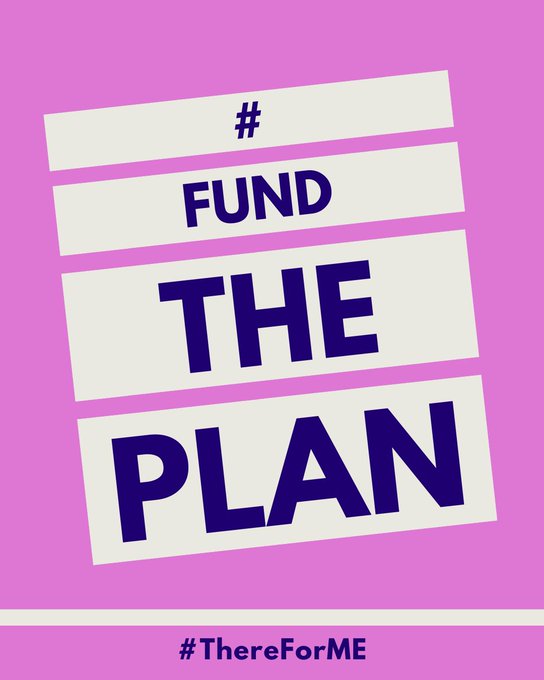
Karen, Emma and Oonagh talk about their campaign group #ThereForME

Julie interviews our three #ThereForME heroes. A relaxed chat about how the campaign came to be, how they all met, how ideas for their campaign tend to crystallise. They talk about the the #FundThePlan initiative and how their campaign might grow in the future.

Buzzfeed link provided above as well as Spotify, as it doesn’t currently require a subscription to listen. Listening via Spotify makes it easier to listen whilst doing something else on your browser or phone.

Find all other episodes in this series here: Living with Long Covid

Similar Posts

  • Hidden Illness, Public Grief, and Research Funding: Why ME/CFS and Other Gradual-Onset Conditions Struggle for Recognition

    Author: Steve Fifield 3rd March 2026

    I wrote a simple draft paper on possible reasons why ME/CFS and similar conditions struggle so much for public recognition and funding.

    Executive Summary

    This briefing paper proposes that illnesses characterised by gradual onset, symptom invisibility, and ambiguous loss—such as Myalgic Encephalomyelitis/Chronic Fatigue Syndrome (ME/CFS)—face structural disadvantages in public recognition and research funding.

    In contrast to diseases associated with sudden, catastrophic diagnoses (e.g., cancer, motor neurone disease, multiple sclerosis), ME/CFS often progresses gradually, without a singular crisis moment that mobilises families, media, and policymakers.

    Drawing on psychological research, communication theory, medical sociology, and health policy analysis, this paper outlines evidence supporting the hypothesis that acute grief catalyses mobilisation, while chronic ambiguity fosters adaptation rather than advocacy.

    1. Proposition Statement

    Public support for disease research funding is strongly influenced by emotional salience, narrative clarity, and visibility.

    • This paper proposes that:
    • Sudden, high-intensity diagnoses generate collective grief and advocacy mobilisation.
    • Gradual, invisible illness trajectories tend to produce adaptation and normalisation rather than public outrage.
    • Conditions lacking clear biomarkers or dramatic ‘trigger events’ may remain socially marginalised and underfunded.

    2. Psychological Evidence: Emotion, Grief, and Giving

    Research in behavioural psychology demonstrates that emotional intensity significantly influences charitable giving and advocacy behaviour.

    • Key evidence includes:
    • The ‘Identifiable Victim Effect’ shows individuals donate more readily when harm is concrete and personal (Small & Loewenstein, 2003).
    • Personal experience with illness strongly predicts sustained advocacy engagement (Bekkers & Wiepking, 2011).
    • Acute grief produces action-oriented coping responses, whereas ambiguous loss can lead to prolonged emotional adjustment rather than mobilisation (Boss, 1999).

    3. Media Visibility and Agenda Setting

    Agenda-setting research demonstrates that media coverage shapes public perceptions of issue importance (McCombs & Shaw, 1972).

    • Relevant dynamics:
    • Diseases with dramatic diagnostic narratives are more likely to receive concentrated media attention.
    • High-visibility campaigns (e.g., viral fundraising movements) significantly increase funding inflows.
    • Invisible or contested illnesses struggle to achieve sustained media framing as urgent biomedical crises.

    4. Medical Sociology: Invisible and Contested Illness

    ME/CFS has historically been classified as a contested or medically unexplained illness.

    • Sociological findings show:
    • Illnesses lacking objective biomarkers often face legitimacy challenges (Barker, 2008).
    • Symptom invisibility contributes to stigma and disbelief (Dickson et al., 2007).
    • Gradual functional decline may be socially normalised within families, reducing collective mobilisation.

    5. Research Funding and Disease Burden

    Multiple analyses indicate that biomedical research funding does not consistently align with disease burden.

    • Findings relevant to ME/CFS:
    • Funding levels for ME/CFS have historically been substantially lower than expected based on disability-adjusted life years (DALYs) (Dimmock et al., 2016).
    • Mortality salience and media visibility correlate more strongly with funding allocation than chronic disability alone.
    • Conditions perceived as life-threatening often secure greater political and philanthropic urgency.

    6. Policy and Strategic Implications

    If this proposition is valid, important implications follow for research institutions, advocacy organisations, and policymakers.

    • Potential strategies:
    • Develop narrative frameworks that communicate cumulative functional loss without sensationalism.
    • Align funding mechanisms more closely with disease burden metrics rather than media salience.
    • Invest in biomarker research to strengthen clinical legitimacy.
    • Promote public education campaigns that clarify the biological basis and severity of ME/CFS.

    Conclusion

    ME/CFS exemplifies how gradual-onset, invisible illnesses may be structurally disadvantaged within public funding ecosystems shaped by emotion, visibility, and narrative shock.

    Addressing this imbalance requires deliberate policy design, improved public communication, and recognition that chronic disability without dramatic rupture can be equally life-altering.

    Selected References

    1. Barker, K. (2008). Electronic support groups, patient-consumers, and medicalization.
    2. Bekkers, R., & Wiepking, P. (2011). A literature review of empirical studies of philanthropy.
    3. Boss, P. (1999). Ambiguous Loss: Learning to Live with Unresolved Grief.
    4. Dickson, A., et al. (2007). Stigma in chronic fatigue syndrome.
    5. Dimmock, M., et al. (2016). Estimating the disease burden of ME/CFS in the United States.
    6. McCombs, M., & Shaw, D. (1972). The agenda-setting function of mass media.
    7. Small, D., & Loewenstein, G. (2003). Helping a victim or helping the victim: Identifiable victim effect.
  • |

    Justice For ME Campaign Launched

    Please share – A very important campaign was launched on the evening of 29th August 2025 to help provide legal support for targeting improvements in medical care, thereby benefiting everyone with ME or Long Covid induced illness.

    “Campaigning for ME (Myalgic Encephalomyelitis) to be medically managed safely, to protect families from permanent disability or death from neglect of the illness”

    Find history, campaign details information and endorsements available on on the Crowd Justice site via the following link: justice4me.uk

    Update 31/08/2025 – On a public facing Facebook comment, where some were discussing the nature of the campaign and potential legal cases, in answer to a question raised by an ME patient, Sarah Boothby (one of the endorsers of the campaign and mother of Maeve Boothby O’Neill, who tragically died from ME in October 2021 aged only 27) shared her understanding of what she believes #JusticeForME is intending (my bold, for emphasis, below):

    “It is a case against the government, for neglecting to deliver a specialist health service in its Final Delivery Plan for ME/cfs.

    Without Consultant led NHS specialist services everyone with #ME in England is denied access to the disability rights other medical conditions are given as granted and, if/when they need hospital treatment, no provision is made for the specialist nursing care demanded by the nature of the illness (hypersensitivies to all sensory stimuli that increase with #PEM). This automatically triggers the worst PEM ever – adding years of the most horrible symptoms to an already horrible illness. The campaign is to stop this neglect.”

    As of this evening (31/08/2025), the campaign has astonishingly already received over £5,000 in pledges of first target of £6,000 within 48 hours of launch, with 28 days still remaining.

    Full details and donations via the link here, taking you to Crowd Justice: justice4me.uk

  • | |

    Petition – STOP the new 4 point PIP rule -Change.org

    Note: Content below copied from Change.org

    https://www.change.org/p/stop-the-new-4-point-pip-rule

    The Issue

    I am a chronically ill Independent PIP Consultant with the goal of providing the kind of support and awareness I WISH was available when I first became chronically ill (I was 29 years old, I am now 47). 

    I am entitled to and do claim PIP myself; this funding changed my life. The Government’s recent decision to introduce a new rule is threatening this lifeline for those who have fought through the invasive, degrading assessment process and finally won. They/we depend on this support. 

    They are saying you now need a MINIMUM score of 4 points in at least ONE daily living activity to keep/get the daily living funding from 2026 (new claims and on reviews). This change WILL deny access to the daily living component to those who are genuinely in need but cannot score the 4 points in a single activity. We know through our experiences the way the scores are allocated rarely match our daily life, many should have had 4 points but do not get this result.

    The Government must reconsider this change. We MUST protect the most vulnerable among us and ensure their dignity through compassionate support. Therefore, we need to urge our Government to reassess this new rule. 

    We need 100,000 signatures and then this (legally) must be discussed in parliament. I am not trying to be our spokesperson but I am trying to unite us. We need to raise our voices so loudly that activists and specialists can continue fighting on our behalf. This is how we help ourselves and those that cannot fight for themselves.

    Remember, YOU, your family, friends, neighbours and co-workers CAN all sign this petition

    It is NOT acceptable to target a vulnerable community WE MUST SPEAK UP and be HEARD

    Please, sign this petition now, please sign for the chronically ill, sign for fairness, and sign for justice.

  • #ThereForME Launches “Fund The Plan” Appeal

    Today, #ThereForME launched a campaign to strike back at the Government asking them to #FundThePlan.

    People with ME were invited to produce a short video appealing to Wes Streeting (Secretary of State for Health ) and Ashley Dalton (recently appointed Under-Secretary of State / Department of Health and Social Care)to allocate new funding to the long awaited UK Delivery Plan for ME

    Read More “#ThereForME Launches “Fund The Plan” Appeal”
  • |

    ‘You don’t want to get better’: the outdated treatment of ME/CFS patients is a national scandal

    This article, published in March 2024 by George Monbiot analyses how medical gaslighting has stopped progress from being made to support people with the debilitating condition of ME/CFS


    Powered by Guardian.co.ukThis article titled “‘You don’t want to get better’: the outdated treatment of ME/CFS patients is a national scandal” was written by George Monbiot, for The Guardian on Tuesday 12th March 2024 08.00 UTC

    It’s the greatest medical scandal of the 21st century. For decades, patients with ME/CFS (myalgic encephalomyelitis/chronic fatigue syndrome) have been told they can make themselves better by changing their attitudes. This devastating condition, which afflicts about 250,000 people in the UK, was psychologised by many doctors and scientists, adding to the burden of a terrible physiological illness.

    Long after this approach was debunked in scientific literature, clinicians who championed it have refused to let go. They continue to influence healthcare systems, governments and health insurers. And patients still suffer as a result.

    ME/CFS saps sufferers of energy and basic physical and cognitive functions, confining many to their homes or even their beds, often shutting down their working lives, social lives and family lives. The extreme seriousness of this condition, and the fact that there is neither a diagnostic test nor a validated treatment, places a special duty of rigour on doctors and researchers. But patient care has been compromised, and useful research inhibited, by the lingering conviction of many practitioners that ME/CFS is “psychosocial”: driven by patients’ beliefs and behaviour.

    This was a story that found me. In 2021, after writing about long Covid, I was accused by the psychiatrist Prof Michael Sharpe of spreading it. Apparently, you could induce such illnesses by discussing them. Investigating further, I was astonished by the failure in his presentation to support his claim with evidence, and perturbed by his lack of satisfactory answers to my questions. Sharpe takes a similarly “biopsychosocial” approach to ME/CFS, one which at the time of his long Covid presentation still dominated medical practice in the UK.

    You can trace the origins of this model to a paper published in 1970. Without assessing a single patient or interviewing a single doctor, it blamed an earlier outbreak of post-viral ME/CFS on “mass hysteria” based on case notes alone. The reasoning included the fact that the outbreak affected more women than men. For centuries, doctors have been readier to classify women’s illnesses as hysterical or psychosomatic than they have men’s. ME/CFS, like long Covid, hits women harder, so, the thinking goes, it must be all in the mind.

    Freedom of information requests to the National Archives show how the biopsychosocial model became embedded in research practice and government policy. The minutes of a meeting on government benefits policy in 1993 give a sense of the position of the psychiatrist Simon Wessely at the time. As summarised in the minutes, he told the meeting that ME/CFS is “not a neurological disorder”. He reportedly claimed that apparently severe cases were likely to result from either a “misdiagnosed psychiatric disorder or poor illness management”, while many cases were “iatrogenic”: caused by medical examination or treatment. His views were apparently that “the worst thing to do is to tell them to rest”, “exercise is good for these patients”, “most cases can be expected to improve with time” and, perhaps most shockingly, “benefits can often make patients worse”.

    Every one of these claims now appears to be without foundation. But they became the basis of the dominant approach in this country to attempting to treat ME/CFS. The toll of patient suffering is hard to imagine.

    In 2007 this belief system became official guidance: the National Institute for Health and Care Excellence (Nice) advocated two treatments arising from the biopsychosocial model of the disease: graded exercise therapy (GET) and cognitive behavioural therapy (CBT). In 2011, a major study, the Pace trial, part-funded by the Department for Work and Pensions, claimed to show that GET and CBT were effective in treating ME/CFS. The study later turned out to be biased and profoundly flawed.

    The believers were championed by the Science Media Centre, of which (now Professor Sir) Simon Wessely was a founder member. Some of the media’s reporting, influenced by the centre, portrayed ME/CFS patients as abusive, threatening, workshy and resistant to treatment.

    As the doctrine spread through the medical profession, some practitioners adopted the same attitudes. A paper promoting psychological treatments lamented the “difficult challenge of … managing patients’ resistance to the treatment”, which arose from “lack of acceptance as to the rationale”. Nurses observed that “the patient should be grateful and follow your advice [but] the patient is quite resistant and there is this thing like you know, ‘The bastards don’t want to get better’.”

    We now know that patients were right to resist interventions that have proved to be both useless and harmful. The impacts were often horrific. A study in Switzerland found that the most powerful factor contributing to suicidal thoughts among people with ME/CFS was “being told the disease was only psychosomatic”.

    Some patients were forced into these treatment regimes, even locked in psychiatric units to make them comply. Some parents of children with ME/CFS were referred to social services for supposedly encouraging their belief that they were ill. Though unevidenced, the biopsychosocial model influenced the government’s social security policy, reinforcing its coercive treatment of people seeking disability benefits.

    In 2020, an independent review by Nice found that the quality of all the research promoting GET and CBT was either “low” or – mostly – “very low”. A paper reported that the thresholds in the 2011 Pace study at which patients were deemed to have recovered had been altered after the trial began. Several studies concluded that GET was actively harmful , as the exercise regime it promoted could worsen patients’ symptoms, causing post-exertional malaise. One paper reported that it was detrimental to the health of at least 50% of patients.

    As a result, in 2021 Nice concluded that GET and CBT should not be used to treat ME/CFS (though more conventional CBT can help patients with the psychological impacts of the illness). Similar shifts had already happened in the United States and the Netherlands. The condition is now correctly recognised as a physiological illness. Last month, a paper in the journal Nature Communications proposed a possible physiological mechanism for the condition.

    But some people never give up. Despite an overwhelming weight of evidence, the old believers, including Sharpe and Wessely, have continued to try to justify their model, obliging Nice recently to publish a strong refutation. Protected by powerful friends in the media, they could breathe life into their hypothesis long after it had been debunked. The new evidence-led thinking has yet to penetrate parts of the health system: some patients are still being mistreated.

    This is not how science should work. Beliefs should be based on evidence. In medicine, there is a double duty: respect the evidence and listen to patients. There is a psychological intervention that could improve the lives of people with ME/CFS: an apology and recognition of the harms they have suffered.

    • George Monbiot is a Guardian columnist

    • Join George Monbiot for a Guardian Live online event on Wednesday 8 May 2024 at 8pm BST. He will be talking about his new book, The Invisible Doctrine: The Secret History of Neoliberalism. Book tickets here

    • Do you have an opinion on the issues raised in this article? If you would like to submit a response of up to 300 words by email to be considered for publication in our letters section, please click here.

    • This article was amended on 12 March 2024 to replace an incorrect hyperlink.

    guardian.co.uk © Guardian News & Media Limited 2010

    Published via the Guardian News Feed plugin for WordPress.

Leave a Reply