Author: Steve

  • Post Vaccination Syndrome (PVS) preprint published by Yale University

    A preprint study from Yale University appears to identify individuals suffering from PVS with elevated levels of circulating isolated spike protein, compared to healthy controls, implying that the source is from a vaccine. Those studied had no prior history or evidence of a SARS-Cov2 infection.

    Researchers have since publication pointed out that Long Covid existed significantly before vaccines were available, defending suggestions from some that Long Covid had somehow been caused purely as a result of vaccination. This is not the case, and PVS forms a very small subset of those suffering with Long Covid Symptoms.

  • Preprint – Incidence and Prevalence of Post-COVID-19 Myalgic Encephalomyelitis: A Report from the Observational RECOVER-Adult Study

    Published: 13 January 2025

    Suzanne D. Vernon PhD, Tianyu Zheng MS, Hyungrok Do PhD, Vincent C. Marconi MD, Leonard A. Jason PhD, Nora G. Singer MD, Benjamin H. Natelson MD, Zaki A. Sherif PhD, Hector Fabio Bonilla MD, Emily Taylor MA, Janet M. Mullington PhD, Hassan Ashktorab PhD, Adeyinka O. Laiyemo MD, Hassan Brim PhD, Thomas F. Patterson MD, Teresa T. Akintonwa BA, Anisha Sekar BA, Michael J. Peluso MD, Nikita Maniar MD, Lucinda Bateman MD, Leora I. Horwitz MD & Rachel Hess MD on behalf of the NIH Researching COVID to Enhance Recovery (RECOVER) Consortium

    Abstract

    Background

    Myalgic encephalomyelitis/chronic fatigue syndrome (ME/CFS) may occur after infection. How often people develop ME/CFS after SARS-CoV-2 infection is unknown.

    Objective

    To determine the incidence and prevalence of post-COVID-19 ME/CFS among adults enrolled in the Researching COVID to Enhance Recovery (RECOVER-Adult) study.

    Design, Setting, and Participants

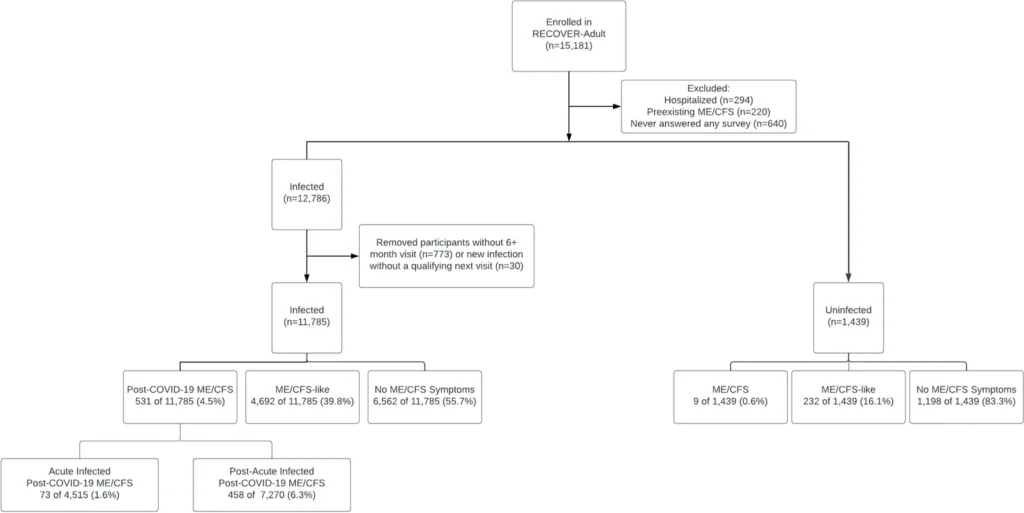
    RECOVER-Adult is a longitudinal observational cohort study conducted across the U.S. We included participants who had a study visit at least 6 months after infection and had no pre-existing ME/CFS, grouped as (1) acute infected, enrolled within 30 days of infection or enrolled as uninfected who became infected (n=4515); (2) post-acute infected, enrolled greater than 30 days after infection (n=7270); and (3) uninfected (1439).

    Measurements

    Incidence rate and prevalence of post-COVID-19 ME/CFS based on the 2015 Institute of Medicine ME/CFS clinical diagnostic criteria.

    Results

    The incidence rate of ME/CFS in participants followed from time of SARS-CoV-2 infection was 2.66 (95% CI 2.63–2.70) per 100 person-years while the rate in matched uninfected participants was 0.93 (95% CI 0.91–10.95) per 100 person-years: a hazard ratio of 4.93 (95% CI 3.62–6.71). The proportion of all RECOVER-Adult participants that met criteria for ME/CFS following SARS-CoV-2 infection was 4.5% (531 of 11,785) compared to 0.6% (9 of 1439) in uninfected participants. Post-exertional malaise was the most common ME/CFS symptom in infected participants (24.0%, 2830 of 11,785). Most participants with post-COVID-19 ME/CFS also met RECOVER criteria for long COVID (88.7%, 471 of 531).

    Limitations

    The ME/CFS clinical diagnostic criteria uses self-reported symptoms. Symptoms can wax and wane.

    Conclusion

    ME/CFS is a diagnosable sequela that develops at an increased rate following SARS-CoV-2 infection. RECOVER provides an unprecedented opportunity to study post-COVID-19 ME/CFS.

    Read the full preprint article here: https://link.springer.com/article/10.1007/s11606-024-09290-9

  • | |

    Preprint – Smartphone-based monitoring of heart rate variability and resting heart rate predicts variability in symptom exacerbations in people with complex chronic illness

    Annie Aitken1; Abbey Sawyer; Akiko Iwasaki; Harlan M. Krumholz; Rory Preston; Harry Leeming; Jenna Tosto-Mancuso; Amy Proal; Michael A. Osborne; David Putrino

    Version 1 posted 29 Nov, 2024

    Abstract

    Background: Complex chronic conditions like Long COVID and Myalgic Encephalomyelitis/Chronic Fatigue Syndrome involve energy limitations and changes in heart rate variability (HRV) and resting heart rate (HR). Mobile health technologies now offer real-time, valid measurements of HRV and HR, advancing symptom monitoring and management. Using a high-density dataset from an observational longitudinal study, we aimed to describe, quantify, and predict within-person co-variations in daily biometric data and subsequent crash, fatigue, and brain fog symptom occurrences.

    Methods: Leveraging data collected through a mobile health app (n=4,244), we developed predictive models using mixed-effects linear regression and logistic regression to explore how within-person fluctuations in biometrics (HR, HRV, and respiratory rate) predict dynamic change in symptomology (crash, fatigue, and brain fog). Predictive performance was assessed using 5-fold stratified cross-validation and compared to a 20% holdout set to evaluate model generalizability to new observations and individuals.

    Results: Across all symptom domains, within-person changes in HRV and HR consistently emerged as key predictors of symptom change across all models, with higher HR and lower HRV conferring risk for crashes, fatigue, and brain fog. Moreover, 7-day biometric stability (or variable dispersion) was a robust predictor of symptom occurrence and severity. Models trained solely on biometric features achieved moderate predictive performance in the stratified cross-validation set; however, incorporating random effects to capture individual-specific variations and prior-day symptom reports substantially enhanced model accuracy, with AUC values reaching .91.

    Discussion and Conclusion: This study is the first to use data-driven models to predict everyday symptom experiences in individuals with complex chronic illnesses based on biometric fluctuations. Findings demonstrate the potential utility of mobile health tools for real-time monitoring of symptoms and highlight the need for further research to refine these predictive models and integrate them into clinical decision-making processes.

    Read the full preprint article here: https://www.researchsquare.com/article/rs-5423422/v1

  • |

    ‘You don’t want to get better’: the outdated treatment of ME/CFS patients is a national scandal

    This article, published in March 2024 by George Monbiot analyses how medical gaslighting has stopped progress from being made to support people with the debilitating condition of ME/CFS


    Powered by Guardian.co.ukThis article titled “‘You don’t want to get better’: the outdated treatment of ME/CFS patients is a national scandal” was written by George Monbiot, for The Guardian on Tuesday 12th March 2024 08.00 UTC

    It’s the greatest medical scandal of the 21st century. For decades, patients with ME/CFS (myalgic encephalomyelitis/chronic fatigue syndrome) have been told they can make themselves better by changing their attitudes. This devastating condition, which afflicts about 250,000 people in the UK, was psychologised by many doctors and scientists, adding to the burden of a terrible physiological illness.

    Long after this approach was debunked in scientific literature, clinicians who championed it have refused to let go. They continue to influence healthcare systems, governments and health insurers. And patients still suffer as a result.

    ME/CFS saps sufferers of energy and basic physical and cognitive functions, confining many to their homes or even their beds, often shutting down their working lives, social lives and family lives. The extreme seriousness of this condition, and the fact that there is neither a diagnostic test nor a validated treatment, places a special duty of rigour on doctors and researchers. But patient care has been compromised, and useful research inhibited, by the lingering conviction of many practitioners that ME/CFS is “psychosocial”: driven by patients’ beliefs and behaviour.

    This was a story that found me. In 2021, after writing about long Covid, I was accused by the psychiatrist Prof Michael Sharpe of spreading it. Apparently, you could induce such illnesses by discussing them. Investigating further, I was astonished by the failure in his presentation to support his claim with evidence, and perturbed by his lack of satisfactory answers to my questions. Sharpe takes a similarly “biopsychosocial” approach to ME/CFS, one which at the time of his long Covid presentation still dominated medical practice in the UK.

    You can trace the origins of this model to a paper published in 1970. Without assessing a single patient or interviewing a single doctor, it blamed an earlier outbreak of post-viral ME/CFS on “mass hysteria” based on case notes alone. The reasoning included the fact that the outbreak affected more women than men. For centuries, doctors have been readier to classify women’s illnesses as hysterical or psychosomatic than they have men’s. ME/CFS, like long Covid, hits women harder, so, the thinking goes, it must be all in the mind.

    Freedom of information requests to the National Archives show how the biopsychosocial model became embedded in research practice and government policy. The minutes of a meeting on government benefits policy in 1993 give a sense of the position of the psychiatrist Simon Wessely at the time. As summarised in the minutes, he told the meeting that ME/CFS is “not a neurological disorder”. He reportedly claimed that apparently severe cases were likely to result from either a “misdiagnosed psychiatric disorder or poor illness management”, while many cases were “iatrogenic”: caused by medical examination or treatment. His views were apparently that “the worst thing to do is to tell them to rest”, “exercise is good for these patients”, “most cases can be expected to improve with time” and, perhaps most shockingly, “benefits can often make patients worse”.

    Every one of these claims now appears to be without foundation. But they became the basis of the dominant approach in this country to attempting to treat ME/CFS. The toll of patient suffering is hard to imagine.

    In 2007 this belief system became official guidance: the National Institute for Health and Care Excellence (Nice) advocated two treatments arising from the biopsychosocial model of the disease: graded exercise therapy (GET) and cognitive behavioural therapy (CBT). In 2011, a major study, the Pace trial, part-funded by the Department for Work and Pensions, claimed to show that GET and CBT were effective in treating ME/CFS. The study later turned out to be biased and profoundly flawed.

    The believers were championed by the Science Media Centre, of which (now Professor Sir) Simon Wessely was a founder member. Some of the media’s reporting, influenced by the centre, portrayed ME/CFS patients as abusive, threatening, workshy and resistant to treatment.

    As the doctrine spread through the medical profession, some practitioners adopted the same attitudes. A paper promoting psychological treatments lamented the “difficult challenge of … managing patients’ resistance to the treatment”, which arose from “lack of acceptance as to the rationale”. Nurses observed that “the patient should be grateful and follow your advice [but] the patient is quite resistant and there is this thing like you know, ‘The bastards don’t want to get better’.”

    We now know that patients were right to resist interventions that have proved to be both useless and harmful. The impacts were often horrific. A study in Switzerland found that the most powerful factor contributing to suicidal thoughts among people with ME/CFS was “being told the disease was only psychosomatic”.

    Some patients were forced into these treatment regimes, even locked in psychiatric units to make them comply. Some parents of children with ME/CFS were referred to social services for supposedly encouraging their belief that they were ill. Though unevidenced, the biopsychosocial model influenced the government’s social security policy, reinforcing its coercive treatment of people seeking disability benefits.

    In 2020, an independent review by Nice found that the quality of all the research promoting GET and CBT was either “low” or – mostly – “very low”. A paper reported that the thresholds in the 2011 Pace study at which patients were deemed to have recovered had been altered after the trial began. Several studies concluded that GET was actively harmful , as the exercise regime it promoted could worsen patients’ symptoms, causing post-exertional malaise. One paper reported that it was detrimental to the health of at least 50% of patients.

    As a result, in 2021 Nice concluded that GET and CBT should not be used to treat ME/CFS (though more conventional CBT can help patients with the psychological impacts of the illness). Similar shifts had already happened in the United States and the Netherlands. The condition is now correctly recognised as a physiological illness. Last month, a paper in the journal Nature Communications proposed a possible physiological mechanism for the condition.

    But some people never give up. Despite an overwhelming weight of evidence, the old believers, including Sharpe and Wessely, have continued to try to justify their model, obliging Nice recently to publish a strong refutation. Protected by powerful friends in the media, they could breathe life into their hypothesis long after it had been debunked. The new evidence-led thinking has yet to penetrate parts of the health system: some patients are still being mistreated.

    This is not how science should work. Beliefs should be based on evidence. In medicine, there is a double duty: respect the evidence and listen to patients. There is a psychological intervention that could improve the lives of people with ME/CFS: an apology and recognition of the harms they have suffered.

    • George Monbiot is a Guardian columnist

    • Join George Monbiot for a Guardian Live online event on Wednesday 8 May 2024 at 8pm BST. He will be talking about his new book, The Invisible Doctrine: The Secret History of Neoliberalism. Book tickets here

    • Do you have an opinion on the issues raised in this article? If you would like to submit a response of up to 300 words by email to be considered for publication in our letters section, please click here.

    • This article was amended on 12 March 2024 to replace an incorrect hyperlink.

    guardian.co.uk © Guardian News & Media Limited 2010

    Published via the Guardian News Feed plugin for WordPress.

  • The Greatest Medical Scandal

    Excerpts from this incredibly accurate and revealing article by George Monbiot, originally published 12 March 2024

    https://www.theguardian.com/commentisfree/2024/mar/12/chronic-fatigue-syndrome-me-treatments-social-services

    ‘You don’t want to get better’: the outdated treatment of ME/CFS patients is a national scandal

    George Monbiot

    George Monbiot

    From harmful ‘therapies’ to social services referrals, the notion that this illness is psychosomatic is having devastating effects

    You don’t want to get better’: the outdated treatment of ME/CFS patients is a national scandal

    George Monbiot

    “It’s the greatest medical scandal of the 21st century. For decades, patients with ME/CFS (myalgic encephalomyelitis/chronic fatigue syndrome) have been told they can make themselves better by changing their attitudes. This devastating condition, which afflicts about 250,000 people in the UK, was psychologised by many doctors and scientists, adding to the burden of a terrible physiological illness”

    “Long after this approach was debunked in scientific literature, clinicians who championed it have refused to let go. They continue to influence healthcare systems, governments and health insurers. And patients still suffer as a result.”

    “ME/CFS saps sufferers of energy and basic physical and cognitive functions, confining many to their homes or even their beds, often shutting down their working lives, social lives and family lives. The extreme seriousness of this condition, and the fact that there is neither a diagnostic test nor a validated treatment, places a special duty of rigour on doctors and researchers. But patient care has been compromised, and useful research inhibited, by the lingering conviction of many practitioners that ME/CFS is “psychosocial”: driven by patients’ beliefs and behaviour.”

  • Why “Dead End” or Dummy pages?

    Because it’s not finished yet!

    Here’s one page that is fairly complete: Long Covid Clinic – What you Can Do

    Where there is content:

    The menus are only partly populated at the moment, and the structure is likely to change, with additional sections appearing below those you see already. If not obvious, the most important part of the navigation menu is the dropdown arrows. When you click on these, they take you to more pages.

    The arrows in the menu above will expand if you click or hover on them to show the featured article pages below, which are well populated in most cases:

    Despite the section below expanding to some interesting sections, there is nothing in there to see yet. In fact most of the main heading pages on the menu don’t exist yet – They will serve as introductions to the content populated further below. The content is being built from the bottom up, as it were.