
Petition – Protect Disabled people who cannot work from planned cuts to benefits
Note: Content below copied from Petition.parliament.uk
https://petition.parliament.uk/petitions/721547
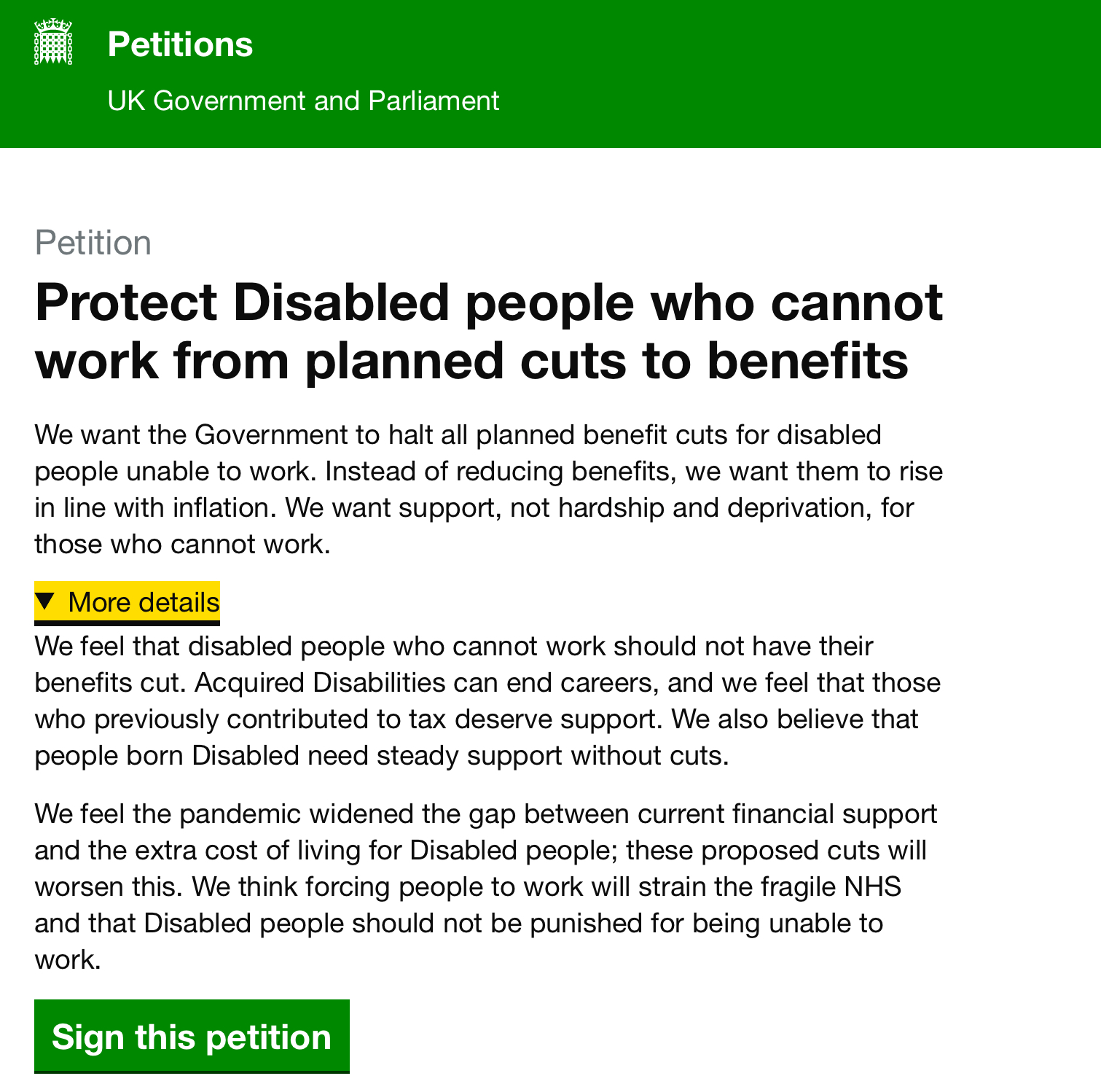
https://petition.parliament.uk/petitions/721547
https://www.change.org/p/stop-the-new-4-point-pip-rule

The Issue
I am a chronically ill Independent PIP Consultant with the goal of providing the kind of support and awareness I WISH was available when I first became chronically ill (I was 29 years old, I am now 47).
I am entitled to and do claim PIP myself; this funding changed my life. The Government’s recent decision to introduce a new rule is threatening this lifeline for those who have fought through the invasive, degrading assessment process and finally won. They/we depend on this support.
They are saying you now need a MINIMUM score of 4 points in at least ONE daily living activity to keep/get the daily living funding from 2026 (new claims and on reviews). This change WILL deny access to the daily living component to those who are genuinely in need but cannot score the 4 points in a single activity. We know through our experiences the way the scores are allocated rarely match our daily life, many should have had 4 points but do not get this result.
The Government must reconsider this change. We MUST protect the most vulnerable among us and ensure their dignity through compassionate support. Therefore, we need to urge our Government to reassess this new rule.
We need 100,000 signatures and then this (legally) must be discussed in parliament. I am not trying to be our spokesperson but I am trying to unite us. We need to raise our voices so loudly that activists and specialists can continue fighting on our behalf. This is how we help ourselves and those that cannot fight for themselves.
Remember, YOU, your family, friends, neighbours and co-workers CAN all sign this petition
It is NOT acceptable to target a vulnerable community WE MUST SPEAK UP and be HEARD
Please, sign this petition now, please sign for the chronically ill, sign for fairness, and sign for justice.
https://action.sense.org.uk/page/169317

The government is proposing making changes to the benefits system. This tool helps you write a response to their consultation. It is designed for disabled people and their families.
The government’s changes are complicated, so we’ve broken things down into four main proposals. Here’s how it works:
- We’ll ask a question or two about each proposal and suggest some things to think about in your answer. You don’t have to respond to every question.
- We’ll compile all your answers into one response.
- Copy this response into an email to send to the Department of Work and Pensions.
This should take about 20 minutes to complete. While that might seem like a lot of time, it’s much more effective to take the time to write a consultation response that is tailored to you.
Continue to complete the form here: https://action.sense.org.uk/page/169317
https://organise.network/actions/petition-stop-proposed-changes-to-pip-zqTA0zIpHYQ/saf/take-action

We urge the Government to:
Cease any changes to PIP eligibility that would reduce access for those in genuine need. Maintain inflation-linked increases to ensure PIP keeps pace with the cost of living. Conduct a transparent and meaningful consultation with disabled people and advocacy groups before implementing any reforms.
We stand against policies that put financial strain on disabled individuals and demand fair, compassionate, and well-evidenced reform.
Sign this petition to protect the rights and support of disabled people in the UK.
Article from “French Daily News” claims “In conclusion, excess glucose can trigger a late relapse (24 to 48 hours later) due to purinergic receptor activation and energy depletion.”
The content does seems more appropriate for a medical journal than a daily paper!
@llamasleaves at Oak Tree Studios has published very informative template, guidance and note to help people with ME to write to their MPs urging them to attend APPG ME meetings, to help with awareness on impacts of benefit changes. More information in the article below:
Email sent on: 24/03/2025 20:23
Dear Munira,
I am writing to express my deep concern regarding the recently proposed cuts to disability benefits, which are expected to reduce the benefits bill by £5 billion by the end of the decade. As someone affected by Myalgic Encephalomyelitis/Chronic Fatigue Syndrome (ME/CFS), I fear these changes will have a significantly detrimental impact on people like me, who rely on this support.
The proposed tightening of eligibility criteria, especially now rejecting summation of different incapacities for Personal Independence Payments (PIP) means that only the most severely disabled will qualify, potentially leaving up to 1.2 million people without essential support. This is particularly concerning for those with ME/CFS, a broadly debilitating neurological condition affecting at least 250,000 people in the UK. Many have developed ME/CFS following COVID-19, further increasing the number of individuals requiring assistance.
Below is an illustration (adapted, please see note below) showing the unfairness of the new points scoring system proposed, where combinations of incapacities would not be considered equivalent e.g. to the proposed score of four or more in one specific incapacity:

PIP Eligible vs PIP Ineligible
The reduction in benefits not only threatens the financial stability of disabled individuals but also risks increasing strain on local councils and the NHS. As people lose access to PIP, they may be forced to rely more heavily on council-funded care services, overwhelming already limited resources and leading to increased administrative and emergency service costs.
I urge you to consider the following actions:
I would be grateful for the opportunity to discuss these concerns further personally and to hear your stance on this critical issue.
I would like to request a face-to-face meeting at one of your Twickenham surgeries in the near future please, if not perhaps a Zoom or a telephone call. Please let me know if and when this would be possible.
Thank you in advance for your attention to this matter.
Yours sincerely,
Steve
Note: Image included above adapted from (totally unrelated) Neurodiversity article by “Teaching Times Group”
Helen Pidd discusses what life is like during and after Long Covid. Emma Gore-Lloyd shares her continuing journey in search of a cure for her partner James, whilst Georgina tells her story of how she got better.
Podcast from the Guardian article: https://www.theguardian.com/news/audio/2025/mar/25/inside-the-mystery-of-long-covid-recovery-podcast
You can also listen directly below:
YouTube links are provided here when available as well as Spotify, as they don’t currently require a subscription to watch / listen. Listening via Spotify makes it easier to listen whilst doing something else on your browser or phone.
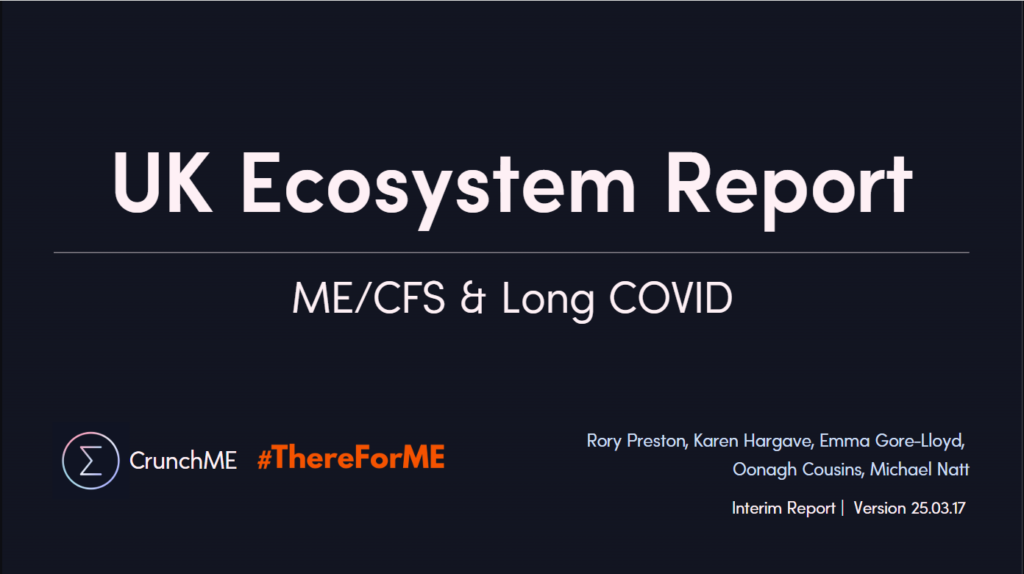
The #ThereForME team have published the first version of their UK Ecosystem Report for ME and Long Covid, created in collaboration with CrunchME. This report maps out key stakeholders and initiatives across the UK, aiming to inform advocacy efforts, policymakers, and potential funders of research and care.
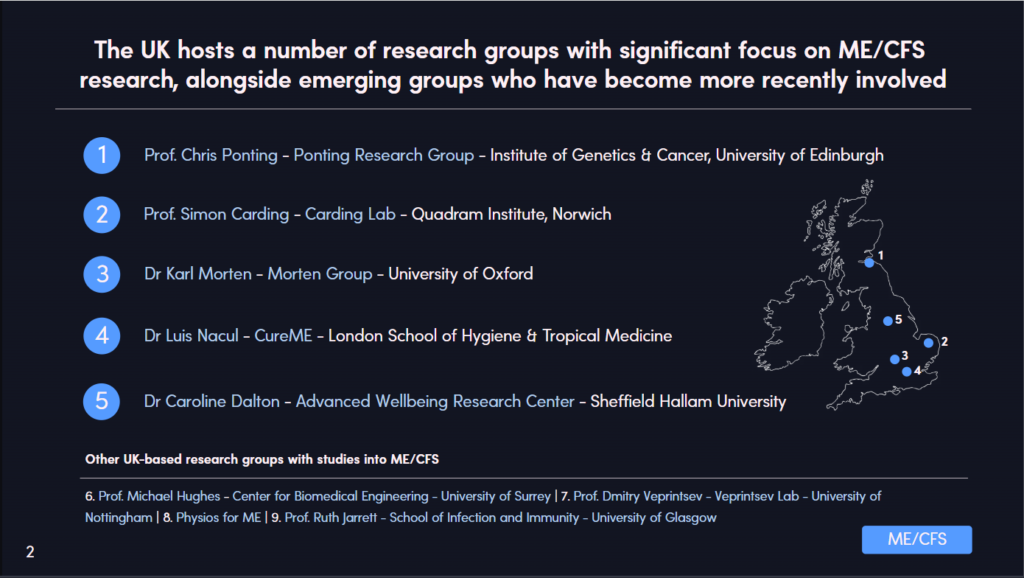
The report tracks active and future ME/CFS research projects within the UK. Following each overview slide like the one below, are detailed additional slides showing the technical nature of the work and interventions being trialled.
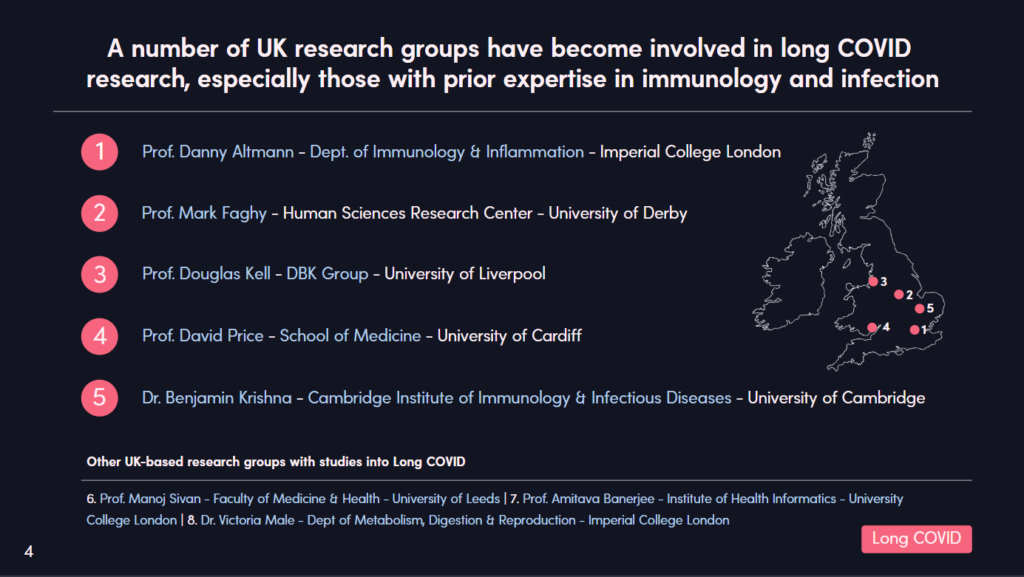
Following slides go in to show research projects for Long Covid within the UK, Clinics and Clinicians, Biotech resource, and forthcoming conferences.
The full UK ecosystem report for ME and Long Covid can be found here
Everything about the #TherForME campaign can be found on the TherForME website
Gez Medinger talks with Prof. Klaus Wirth about his research into Mitochondrial Dysfunction, particularly in relation to intramuscular sodium levels. He reassures us that intramuscular sodium levels are not influenced by additional salt intake typically used to increase blood volume, for those suffering from orthostatic intolerance or POTS.
Part 2 looks at use of a potential new drug, referred to as MDC002: