Follow-up project to DecodeME will analysye complete Genome sequences of 9000 ME/CFS existing samples to help pinpoint biology of ME and hopefully lead to treatments. Loads of detail in this article by Simon McGrath about how the DNA will be sequenced etc. using Oxford Nanopore technology.
It is ME Awareness Day and I’ve had a tough one, so I’ll write a bit more soon… But didn’t want to forget documenting here what seems a major step in the right direction.
Gez Medinger talks with Prof. Klaus Wirth about his research into Mitochondrial Dysfunction, particularly in relation to intramuscular sodium levels. He reassures us that intramuscular sodium levels are not influenced by additional salt intake typically used to increase blood volume, for those suffering from orthostatic intolerance or POTS.
Part 2 looks at use of a potential new drug, referred to as MDC002:
Annie Aitken1; Abbey Sawyer; Akiko Iwasaki; Harlan M. Krumholz; Rory Preston; Harry Leeming; Jenna Tosto-Mancuso; Amy Proal; Michael A. Osborne; David Putrino
Version 1 posted 29 Nov, 2024
Abstract
Background: Complex chronic conditions like Long COVID and Myalgic Encephalomyelitis/Chronic Fatigue Syndrome involve energy limitations and changes in heart rate variability (HRV) and resting heart rate (HR). Mobile health technologies now offer real-time, valid measurements of HRV and HR, advancing symptom monitoring and management. Using a high-density dataset from an observational longitudinal study, we aimed to describe, quantify, and predict within-person co-variations in daily biometric data and subsequent crash, fatigue, and brain fog symptom occurrences.
Methods: Leveraging data collected through a mobile health app (n=4,244), we developed predictive models using mixed-effects linear regression and logistic regression to explore how within-person fluctuations in biometrics (HR, HRV, and respiratory rate) predict dynamic change in symptomology (crash, fatigue, and brain fog). Predictive performance was assessed using 5-fold stratified cross-validation and compared to a 20% holdout set to evaluate model generalizability to new observations and individuals.
Results: Across all symptom domains, within-person changes in HRV and HR consistently emerged as key predictors of symptom change across all models, with higher HR and lower HRV conferring risk for crashes, fatigue, and brain fog. Moreover, 7-day biometric stability (or variable dispersion) was a robust predictor of symptom occurrence and severity. Models trained solely on biometric features achieved moderate predictive performance in the stratified cross-validation set; however, incorporating random effects to capture individual-specific variations and prior-day symptom reports substantially enhanced model accuracy, with AUC values reaching .91.
Discussion and Conclusion: This study is the first to use data-driven models to predict everyday symptom experiences in individuals with complex chronic illnesses based on biometric fluctuations. Findings demonstrate the potential utility of mobile health tools for real-time monitoring of symptoms and highlight the need for further research to refine these predictive models and integrate them into clinical decision-making processes.
Suzanne D. Vernon PhD, Tianyu Zheng MS, Hyungrok Do PhD, Vincent C. Marconi MD, Leonard A. Jason PhD, Nora G. Singer MD, Benjamin H. Natelson MD, Zaki A. Sherif PhD, Hector Fabio Bonilla MD, Emily Taylor MA, Janet M. Mullington PhD, Hassan Ashktorab PhD, Adeyinka O. Laiyemo MD, Hassan Brim PhD, Thomas F. Patterson MD, Teresa T. Akintonwa BA, Anisha Sekar BA, Michael J. Peluso MD, Nikita Maniar MD, Lucinda Bateman MD, Leora I. Horwitz MD & Rachel Hess MD on behalf of the NIH Researching COVID to Enhance Recovery (RECOVER) Consortium
Abstract
Background
Myalgic encephalomyelitis/chronic fatigue syndrome (ME/CFS) may occur after infection. How often people develop ME/CFS after SARS-CoV-2 infection is unknown.
Objective
To determine the incidence and prevalence of post-COVID-19 ME/CFS among adults enrolled in the Researching COVID to Enhance Recovery (RECOVER-Adult) study.
Design, Setting, and Participants
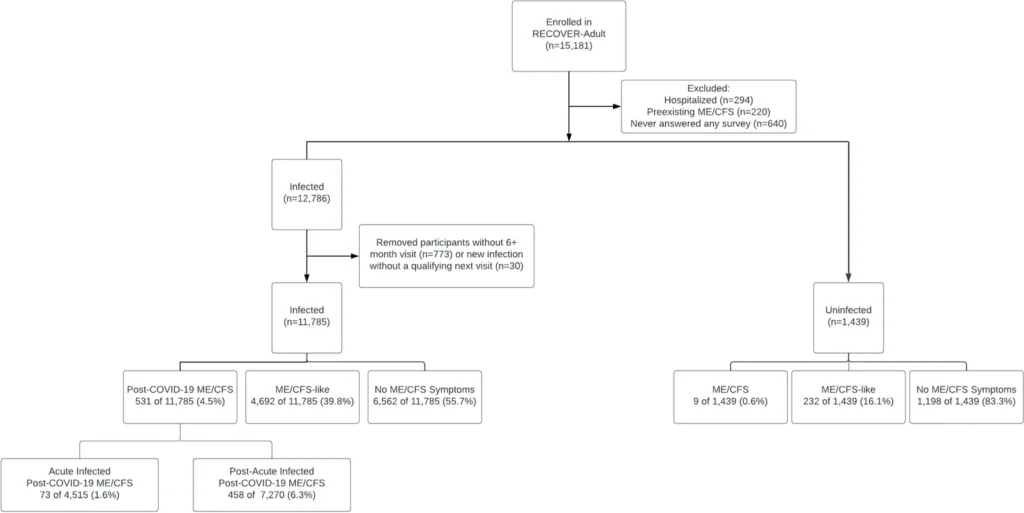
RECOVER-Adult is a longitudinal observational cohort study conducted across the U.S. We included participants who had a study visit at least 6 months after infection and had no pre-existing ME/CFS, grouped as (1) acute infected, enrolled within 30 days of infection or enrolled as uninfected who became infected (n=4515); (2) post-acute infected, enrolled greater than 30 days after infection (n=7270); and (3) uninfected (1439).
Measurements
Incidence rate and prevalence of post-COVID-19 ME/CFS based on the 2015 Institute of Medicine ME/CFS clinical diagnostic criteria.
Results
The incidence rate of ME/CFS in participants followed from time of SARS-CoV-2 infection was 2.66 (95% CI 2.63–2.70) per 100 person-years while the rate in matched uninfected participants was 0.93 (95% CI 0.91–10.95) per 100 person-years: a hazard ratio of 4.93 (95% CI 3.62–6.71). The proportion of all RECOVER-Adult participants that met criteria for ME/CFS following SARS-CoV-2 infection was 4.5% (531 of 11,785) compared to 0.6% (9 of 1439) in uninfected participants. Post-exertional malaise was the most common ME/CFS symptom in infected participants (24.0%, 2830 of 11,785). Most participants with post-COVID-19 ME/CFS also met RECOVER criteria for long COVID (88.7%, 471 of 531).
Limitations
The ME/CFS clinical diagnostic criteria uses self-reported symptoms. Symptoms can wax and wane.
Conclusion
ME/CFS is a diagnosable sequela that develops at an increased rate following SARS-CoV-2 infection. RECOVER provides an unprecedented opportunity to study post-COVID-19 ME/CFS.
‘Reflect, Collaborate and Listen’ looks at why doctors don’t listen and the urgent need to rebalance the power dynamic in the patient – doctor relationship.
✨My essay in @TheLancet this week has made the front page!✨ (I didn’t know about this 🤗)
‘Reflect, Collaborate and Listen’ looks at why doctors don’t listen and the urgent need to rebalance the power dynamic in the patient – doctor relationship.https://t.co/TusGTRBa8fpic.twitter.com/BmUVuYccmw
Extracts from full Mayo Clinic Article Originally published in October 2023. Selected text and images only included below see full article link at end of page
Concise review for clinicians Volume 98, Issue 10, p1544-1551, October 2023: Stephanie L. Grach, MD, Jaime Seltzer, MS, Tony Y. Chon, MD, Ravindra Ganesh, MD, MBBS
Extract – Abstract
Myalgic encephalomyelitis/chronic fatigue syndrome (ME/CFS) is a chronic neurologic disease often preceded by infection. There has been increased interest in ME/CFS recently because of its significant overlap with the post-COVID syndrome (long COVID or post-acute sequelae of COVID), with several studies estimating that half of patients with post-COVID syndrome fulfill ME/CFS criteria. Our concise review describes a generalist approach to ME/CFS, including diagnosis, evaluation, and management strategies. (c) 2023 THE AUTHORS. Published by Elsevier Inc on behalf of Mayo Foundation for Medical Education and Research. This is an open access article under the CC BY-NC-ND license (http://creativecommons.org/licenses/by-nc-nd/4.0/) n Mayo Clin Proc. 2023;98(10):1544-1551