Gez Medinger talks with Prof. Klaus Wirth about his research into Mitochondrial Dysfunction, particularly in relation to intramuscular sodium levels. He reassures us that intramuscular sodium levels are not influenced by additional salt intake typically used to increase blood volume, for those suffering from orthostatic intolerance or POTS.
Part 2 looks at use of a potential new drug, referred to as MDC002:
Harry Leeming introduces the Visible App and wearable armband
Harry Leeming introduces the Visible App monitoring and wearable armband, allowing daily symptom tracking, morning Heart Rate Variation measurement (even without the armband) and with the armband, continuous Heart Rate monitoring and Pace Point scoring.
Dianna Cowern, also known as “The Physics Girl” after her massively successful YouTube channel, wants people to know about the disease ME/CFS. In May 2025, Dianna Cowern updates us on her journey and recovery following a Covid infection in Autumn of 2023. Dianna reveals that she’s made progress and beginning to be able to enjoy some limited activities. Whilst she is recovering, she parallels the continued severe suffering of her friend Tobias Schweikert who lives in Germany, reminding us that so much more needs to be done worldwide for those who continue to suffer, with no end in sight.
Kyle (Dianna’s Husband): “It’s been over two years of being sick essentially approaching two years of like bed bound her quality of life is unimaginably low right now still she can’t get out of bed she can’t clean herself she can’t take a shower she can’t…”
Derek Muller (Veritasium): “I think the thing that’s shocking to me as well is like this lack of ability to have anything really to occupy your mind right like it’s not like she can’t really read or audio books or movies.”
A Meta Study, Comparing ME/CFS and Long Covid symptoms and quality of life. From the conclusions section:
Shared impact patterns were observed between the two illness cohorts. Profound impairments were consistently observed in self-perceptions of overall health status, physical health domains and ability to perform daily activities. Although only provided in one study, there were no significant differences in direct comparisons of HRQoL outcomes between pwME/CFS and pwPCC.
Suzanne D. Vernon PhD, Tianyu Zheng MS, Hyungrok Do PhD, Vincent C. Marconi MD, Leonard A. Jason PhD, Nora G. Singer MD, Benjamin H. Natelson MD, Zaki A. Sherif PhD, Hector Fabio Bonilla MD, Emily Taylor MA, Janet M. Mullington PhD, Hassan Ashktorab PhD, Adeyinka O. Laiyemo MD, Hassan Brim PhD, Thomas F. Patterson MD, Teresa T. Akintonwa BA, Anisha Sekar BA, Michael J. Peluso MD, Nikita Maniar MD, Lucinda Bateman MD, Leora I. Horwitz MD & Rachel Hess MD on behalf of the NIH Researching COVID to Enhance Recovery (RECOVER) Consortium
Abstract
Background
Myalgic encephalomyelitis/chronic fatigue syndrome (ME/CFS) may occur after infection. How often people develop ME/CFS after SARS-CoV-2 infection is unknown.
Objective
To determine the incidence and prevalence of post-COVID-19 ME/CFS among adults enrolled in the Researching COVID to Enhance Recovery (RECOVER-Adult) study.
Design, Setting, and Participants
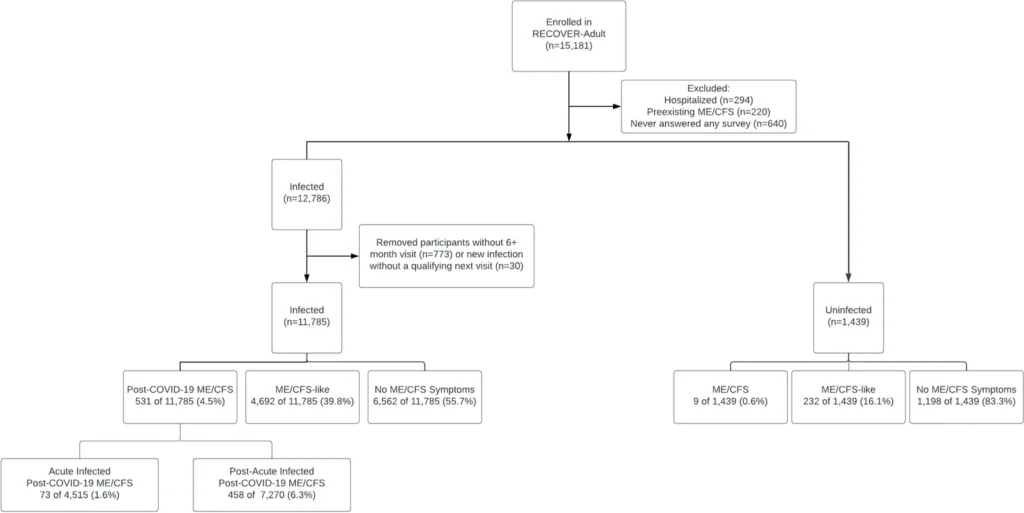
RECOVER-Adult is a longitudinal observational cohort study conducted across the U.S. We included participants who had a study visit at least 6 months after infection and had no pre-existing ME/CFS, grouped as (1) acute infected, enrolled within 30 days of infection or enrolled as uninfected who became infected (n=4515); (2) post-acute infected, enrolled greater than 30 days after infection (n=7270); and (3) uninfected (1439).
Measurements
Incidence rate and prevalence of post-COVID-19 ME/CFS based on the 2015 Institute of Medicine ME/CFS clinical diagnostic criteria.
Results
The incidence rate of ME/CFS in participants followed from time of SARS-CoV-2 infection was 2.66 (95% CI 2.63–2.70) per 100 person-years while the rate in matched uninfected participants was 0.93 (95% CI 0.91–10.95) per 100 person-years: a hazard ratio of 4.93 (95% CI 3.62–6.71). The proportion of all RECOVER-Adult participants that met criteria for ME/CFS following SARS-CoV-2 infection was 4.5% (531 of 11,785) compared to 0.6% (9 of 1439) in uninfected participants. Post-exertional malaise was the most common ME/CFS symptom in infected participants (24.0%, 2830 of 11,785). Most participants with post-COVID-19 ME/CFS also met RECOVER criteria for long COVID (88.7%, 471 of 531).
Limitations
The ME/CFS clinical diagnostic criteria uses self-reported symptoms. Symptoms can wax and wane.
Conclusion
ME/CFS is a diagnosable sequela that develops at an increased rate following SARS-CoV-2 infection. RECOVER provides an unprecedented opportunity to study post-COVID-19 ME/CFS.