| |

New Abstract on invasive CPET – Promising outcomes

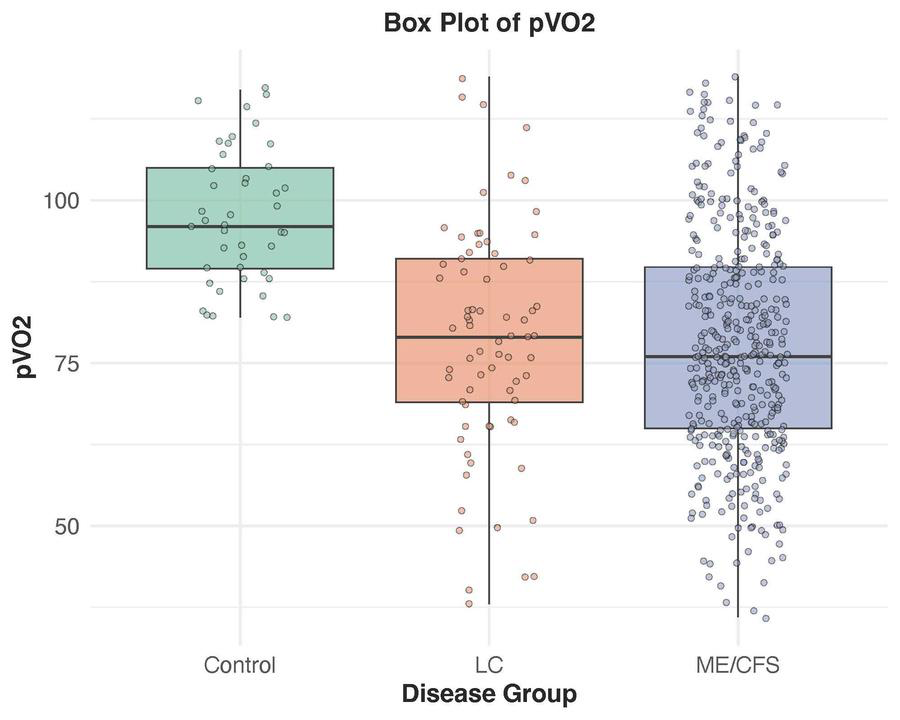
The American Journal of Respiratory and Critical Care Medicine has posted a new abstract authored by David Systrom et al, which evaluated invasive CPET testing. The test includes iCPET results from 438 ME/CFS patients, 73 Long Covid patients, and 43 symptomatic but otherwise normal controls.

The measurement method is illustrated here from their previous 2023 report [TBA]

The full Abstract within the American Journal of Respiratory and Critical Care Medicine can be found here: https://www.atsjournals.org/doi/abs/10.1164/ajrccm.2025.211.Abstracts.A7881

An image extract from the article is shown below, showing correlation of pVO2 between each cohort and outcomes, and remarkably similar results from ME and Long Covid:

Similar Posts

  • Health-related quality of life in Myalgic Encephalomyelitis/Chronic Fatigue Syndrome and Post COVID-19 Condition: a systematic review

    A Meta Study, Comparing ME/CFS and Long Covid symptoms and quality of life. From the conclusions section:

     Shared impact patterns were observed between the two illness cohorts. Profound impairments were consistently observed in self-perceptions of overall health status, physical health domains and ability to perform daily activities. Although only provided in one study, there were no significant differences in direct comparisons of HRQoL outcomes between pwME/CFS and pwPCC.

    Read More “Health-related quality of life in Myalgic Encephalomyelitis/Chronic Fatigue Syndrome and Post COVID-19 Condition: a systematic review”
  • Hidden Illness, Public Grief, and Research Funding: Why ME/CFS and Other Gradual-Onset Conditions Struggle for Recognition

    Author: Steve Fifield 3rd March 2026

    I wrote a simple draft paper on possible reasons why ME/CFS and similar conditions struggle so much for public recognition and funding.

    Executive Summary

    This briefing paper proposes that illnesses characterised by gradual onset, symptom invisibility, and ambiguous loss—such as Myalgic Encephalomyelitis/Chronic Fatigue Syndrome (ME/CFS)—face structural disadvantages in public recognition and research funding.

    In contrast to diseases associated with sudden, catastrophic diagnoses (e.g., cancer, motor neurone disease, multiple sclerosis), ME/CFS often progresses gradually, without a singular crisis moment that mobilises families, media, and policymakers.

    Drawing on psychological research, communication theory, medical sociology, and health policy analysis, this paper outlines evidence supporting the hypothesis that acute grief catalyses mobilisation, while chronic ambiguity fosters adaptation rather than advocacy.

    1. Proposition Statement

    Public support for disease research funding is strongly influenced by emotional salience, narrative clarity, and visibility.

    • This paper proposes that:
    • Sudden, high-intensity diagnoses generate collective grief and advocacy mobilisation.
    • Gradual, invisible illness trajectories tend to produce adaptation and normalisation rather than public outrage.
    • Conditions lacking clear biomarkers or dramatic ‘trigger events’ may remain socially marginalised and underfunded.

    2. Psychological Evidence: Emotion, Grief, and Giving

    Research in behavioural psychology demonstrates that emotional intensity significantly influences charitable giving and advocacy behaviour.

    • Key evidence includes:
    • The ‘Identifiable Victim Effect’ shows individuals donate more readily when harm is concrete and personal (Small & Loewenstein, 2003).
    • Personal experience with illness strongly predicts sustained advocacy engagement (Bekkers & Wiepking, 2011).
    • Acute grief produces action-oriented coping responses, whereas ambiguous loss can lead to prolonged emotional adjustment rather than mobilisation (Boss, 1999).

    3. Media Visibility and Agenda Setting

    Agenda-setting research demonstrates that media coverage shapes public perceptions of issue importance (McCombs & Shaw, 1972).

    • Relevant dynamics:
    • Diseases with dramatic diagnostic narratives are more likely to receive concentrated media attention.
    • High-visibility campaigns (e.g., viral fundraising movements) significantly increase funding inflows.
    • Invisible or contested illnesses struggle to achieve sustained media framing as urgent biomedical crises.

    4. Medical Sociology: Invisible and Contested Illness

    ME/CFS has historically been classified as a contested or medically unexplained illness.

    • Sociological findings show:
    • Illnesses lacking objective biomarkers often face legitimacy challenges (Barker, 2008).
    • Symptom invisibility contributes to stigma and disbelief (Dickson et al., 2007).
    • Gradual functional decline may be socially normalised within families, reducing collective mobilisation.

    5. Research Funding and Disease Burden

    Multiple analyses indicate that biomedical research funding does not consistently align with disease burden.

    • Findings relevant to ME/CFS:
    • Funding levels for ME/CFS have historically been substantially lower than expected based on disability-adjusted life years (DALYs) (Dimmock et al., 2016).
    • Mortality salience and media visibility correlate more strongly with funding allocation than chronic disability alone.
    • Conditions perceived as life-threatening often secure greater political and philanthropic urgency.

    6. Policy and Strategic Implications

    If this proposition is valid, important implications follow for research institutions, advocacy organisations, and policymakers.

    • Potential strategies:
    • Develop narrative frameworks that communicate cumulative functional loss without sensationalism.
    • Align funding mechanisms more closely with disease burden metrics rather than media salience.
    • Invest in biomarker research to strengthen clinical legitimacy.
    • Promote public education campaigns that clarify the biological basis and severity of ME/CFS.

    Conclusion

    ME/CFS exemplifies how gradual-onset, invisible illnesses may be structurally disadvantaged within public funding ecosystems shaped by emotion, visibility, and narrative shock.

    Addressing this imbalance requires deliberate policy design, improved public communication, and recognition that chronic disability without dramatic rupture can be equally life-altering.

    Selected References

    1. Barker, K. (2008). Electronic support groups, patient-consumers, and medicalization.
    2. Bekkers, R., & Wiepking, P. (2011). A literature review of empirical studies of philanthropy.
    3. Boss, P. (1999). Ambiguous Loss: Learning to Live with Unresolved Grief.
    4. Dickson, A., et al. (2007). Stigma in chronic fatigue syndrome.
    5. Dimmock, M., et al. (2016). Estimating the disease burden of ME/CFS in the United States.
    6. McCombs, M., & Shaw, D. (1972). The agenda-setting function of mass media.
    7. Small, D., & Loewenstein, G. (2003). Helping a victim or helping the victim: Identifiable victim effect.
  • | |

    All 72 Liberal Democrat MPs back resourcing of ME/CFS Delivery Plan

    Tessa Munt, officer of the APPG for ME, announced that 100% Liberal Democrat MPs have now signed a letter urging Wes Streeting and Ashley Dalton to back the ME/CFS Delivery Plan with the funding required to properly implement it.

    Tessa Munt – “I’m so delighted that all 72 LibDem MPs signed this letter to @wesstreeting @AshleyDalton_MP asking the govt to back the ME/CFS Delivery Plan with the resources it deserves. May this be a huge encouragement to the ME community and the start of meaningful change. #WorldMEDay”

  • |

    Reflect, Collaborate and Listen

    ‘Reflect, Collaborate and Listen’ looks at why doctors don’t listen and the urgent need to rebalance the power dynamic in the patient – doctor relationship.

    Dr Rageshri Dhairyawan

    See the full article here in the Lancet – It is free to download (after registration, which is very straightforward).

  • Karen, Emma and Oonagh talk about their campaign group #ThereForME

    Julie interviews our three #ThereForME heroes. A relaxed chat about how the campaign came to be, how they all met, how ideas for their campaign tend to crystallise. They talk about the the #FundThePlan initiative and how their campaign might grow in the future.

    Buzzfeed link provided above as well as Spotify, as it doesn’t currently require a subscription to listen. Listening via Spotify makes it easier to listen whilst doing something else on your browser or phone.

    Find all other episodes in this series here: Living with Long Covid

  • |

    Justice For ME Campaign Launched

    Please share – A very important campaign was launched on the evening of 29th August 2025 to help provide legal support for targeting improvements in medical care, thereby benefiting everyone with ME or Long Covid induced illness.

    “Campaigning for ME (Myalgic Encephalomyelitis) to be medically managed safely, to protect families from permanent disability or death from neglect of the illness”

    Find history, campaign details information and endorsements available on on the Crowd Justice site via the following link: justice4me.uk

    Update 31/08/2025 – On a public facing Facebook comment, where some were discussing the nature of the campaign and potential legal cases, in answer to a question raised by an ME patient, Sarah Boothby (one of the endorsers of the campaign and mother of Maeve Boothby O’Neill, who tragically died from ME in October 2021 aged only 27) shared her understanding of what she believes #JusticeForME is intending (my bold, for emphasis, below):

    “It is a case against the government, for neglecting to deliver a specialist health service in its Final Delivery Plan for ME/cfs.

    Without Consultant led NHS specialist services everyone with #ME in England is denied access to the disability rights other medical conditions are given as granted and, if/when they need hospital treatment, no provision is made for the specialist nursing care demanded by the nature of the illness (hypersensitivies to all sensory stimuli that increase with #PEM). This automatically triggers the worst PEM ever – adding years of the most horrible symptoms to an already horrible illness. The campaign is to stop this neglect.”

    As of this evening (31/08/2025), the campaign has astonishingly already received over £5,000 in pledges of first target of £6,000 within 48 hours of launch, with 28 days still remaining.

    Full details and donations via the link here, taking you to Crowd Justice: justice4me.uk

Leave a Reply