Health-related quality of life in Myalgic Encephalomyelitis/Chronic Fatigue Syndrome and Post COVID-19 Condition: a systematic review

A Meta Study, Comparing ME/CFS and Long Covid symptoms and quality of life. From the conclusions section:

 Shared impact patterns were observed between the two illness cohorts. Profound impairments were consistently observed in self-perceptions of overall health status, physical health domains and ability to perform daily activities. Although only provided in one study, there were no significant differences in direct comparisons of HRQoL outcomes between pwME/CFS and pwPCC.

Abstract

Purpose

Myalgic Encephalomyelitis/Chronic Fatigue Syndrome (ME/CFS) and Post COVID-19 Condition (PCC) are debilitating, chronic multi-systemic illnesses that require multidisciplinary care. However, people with ME/CFS (pwME/CFS) and people with PCC (pwPCC) are often precluded from accessing necessary disability and social support services. These unmet care needs exacerbate the existing illness burdens experienced by pwME/CFS and pwPCC. To deliver appropriate care and optimise health outcomes for pwME/CFS and pwPCC, the development of evidence-based healthcare policies that recognise the disabling impacts of these illnesses must be prioritised. This systematic review summarises the health-related quality of life (HRQoL) of pwME/CFS and pwPCC when compared with healthy controls (HCs) to elucidate the impacts of these illnesses and guide healthcare policy reform.

Methods

CINAHL, Embase, MEDLINE, PubMed, PsycINFO and the Web of Science Core Collection were systematically searched from 1st January 2003 to 23rd July 2024. Eligible publications included observational studies capturing quantitative HRQoL data among pwME/CFS or pwPCC when compared with HCs. The use of validated patient-reported outcome measures (PROMs) was mandatory. Eligible studies were also required to employ the most stringent diagnostic criteria currently available, including the Canadian Consensus Criteria or International Consensus Criteria for ME/CFS and the World Health Organization case definition for PCC (PROSPERO ID: CRD42024501309).

Results

This review captured 16 studies, including eight studies among pwME/CFS, seven studies among pwPCC and one study among both illness cohorts. Most participants were female and middle-aged. All pwPCC had experienced prolonged COVID-19 symptoms for at least three months. When compared with HCs, all HRQoL domains were significantly impaired among pwME/CFS and pwPCC. Both illnesses had a salient impact on physical health, including pain and ability to perform daily and work activities. While direct comparisons between pwME/CFS and pwPCC were limited by inconsistencies in the PROMs employed, comparable impact trends across HRQoL domain scores were observed.

Conclusion

ME/CFS and PCC have similar, profound impacts on HRQoL that warrant access to multidisciplinary disability and social support services. Future research must harmonise HRQoL data collection and prioritise longitudinal investigations among pwME/CFS and pwPCC to characterise PCC subgroups (including those fulfilling ME/CFS criteria) and predictors of prognosis.

Read the full article here:

Health-related quality of life in Myalgic Encephalomyelitis/Chronic Fatigue Syndrome and Post COVID-19 Condition: a systematic review

Similar Posts

  • |

    Reflect, Collaborate and Listen

    ‘Reflect, Collaborate and Listen’ looks at why doctors don’t listen and the urgent need to rebalance the power dynamic in the patient – doctor relationship.

    Dr Rageshri Dhairyawan

    See the full article here in the Lancet – It is free to download (after registration, which is very straightforward).

  • Preprint – Incidence and Prevalence of Post-COVID-19 Myalgic Encephalomyelitis: A Report from the Observational RECOVER-Adult Study

    Published: 13 January 2025

    Suzanne D. Vernon PhD, Tianyu Zheng MS, Hyungrok Do PhD, Vincent C. Marconi MD, Leonard A. Jason PhD, Nora G. Singer MD, Benjamin H. Natelson MD, Zaki A. Sherif PhD, Hector Fabio Bonilla MD, Emily Taylor MA, Janet M. Mullington PhD, Hassan Ashktorab PhD, Adeyinka O. Laiyemo MD, Hassan Brim PhD, Thomas F. Patterson MD, Teresa T. Akintonwa BA, Anisha Sekar BA, Michael J. Peluso MD, Nikita Maniar MD, Lucinda Bateman MD, Leora I. Horwitz MD & Rachel Hess MD on behalf of the NIH Researching COVID to Enhance Recovery (RECOVER) Consortium

    Abstract

    Background

    Myalgic encephalomyelitis/chronic fatigue syndrome (ME/CFS) may occur after infection. How often people develop ME/CFS after SARS-CoV-2 infection is unknown.

    Objective

    To determine the incidence and prevalence of post-COVID-19 ME/CFS among adults enrolled in the Researching COVID to Enhance Recovery (RECOVER-Adult) study.

    Design, Setting, and Participants

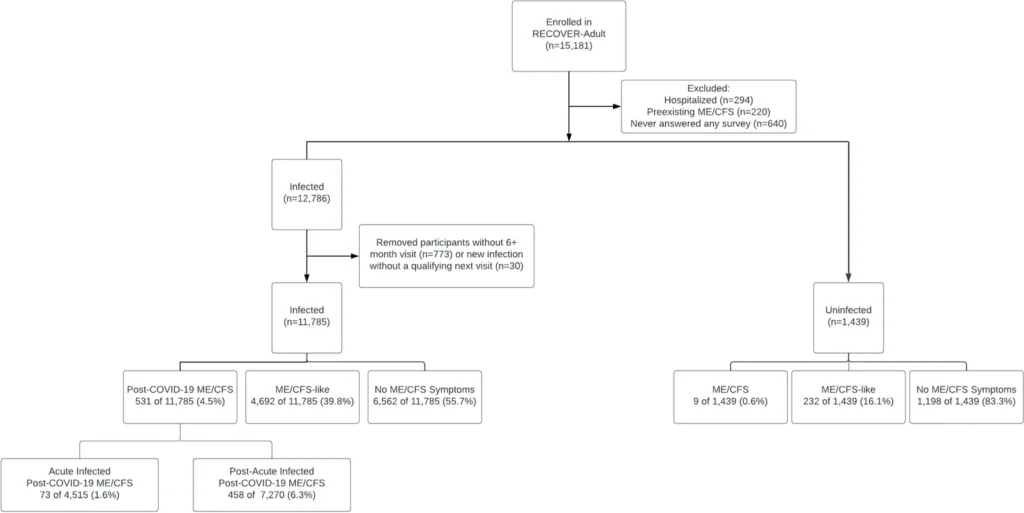
    RECOVER-Adult is a longitudinal observational cohort study conducted across the U.S. We included participants who had a study visit at least 6 months after infection and had no pre-existing ME/CFS, grouped as (1) acute infected, enrolled within 30 days of infection or enrolled as uninfected who became infected (n=4515); (2) post-acute infected, enrolled greater than 30 days after infection (n=7270); and (3) uninfected (1439).

    Measurements

    Incidence rate and prevalence of post-COVID-19 ME/CFS based on the 2015 Institute of Medicine ME/CFS clinical diagnostic criteria.

    Results

    The incidence rate of ME/CFS in participants followed from time of SARS-CoV-2 infection was 2.66 (95% CI 2.63–2.70) per 100 person-years while the rate in matched uninfected participants was 0.93 (95% CI 0.91–10.95) per 100 person-years: a hazard ratio of 4.93 (95% CI 3.62–6.71). The proportion of all RECOVER-Adult participants that met criteria for ME/CFS following SARS-CoV-2 infection was 4.5% (531 of 11,785) compared to 0.6% (9 of 1439) in uninfected participants. Post-exertional malaise was the most common ME/CFS symptom in infected participants (24.0%, 2830 of 11,785). Most participants with post-COVID-19 ME/CFS also met RECOVER criteria for long COVID (88.7%, 471 of 531).

    Limitations

    The ME/CFS clinical diagnostic criteria uses self-reported symptoms. Symptoms can wax and wane.

    Conclusion

    ME/CFS is a diagnosable sequela that develops at an increased rate following SARS-CoV-2 infection. RECOVER provides an unprecedented opportunity to study post-COVID-19 ME/CFS.

    Read the full preprint article here: https://link.springer.com/article/10.1007/s11606-024-09290-9

  • | |

    Preprint – Smartphone-based monitoring of heart rate variability and resting heart rate predicts variability in symptom exacerbations in people with complex chronic illness

    Annie Aitken1; Abbey Sawyer; Akiko Iwasaki; Harlan M. Krumholz; Rory Preston; Harry Leeming; Jenna Tosto-Mancuso; Amy Proal; Michael A. Osborne; David Putrino

    Version 1 posted 29 Nov, 2024

    Abstract

    Background: Complex chronic conditions like Long COVID and Myalgic Encephalomyelitis/Chronic Fatigue Syndrome involve energy limitations and changes in heart rate variability (HRV) and resting heart rate (HR). Mobile health technologies now offer real-time, valid measurements of HRV and HR, advancing symptom monitoring and management. Using a high-density dataset from an observational longitudinal study, we aimed to describe, quantify, and predict within-person co-variations in daily biometric data and subsequent crash, fatigue, and brain fog symptom occurrences.

    Methods: Leveraging data collected through a mobile health app (n=4,244), we developed predictive models using mixed-effects linear regression and logistic regression to explore how within-person fluctuations in biometrics (HR, HRV, and respiratory rate) predict dynamic change in symptomology (crash, fatigue, and brain fog). Predictive performance was assessed using 5-fold stratified cross-validation and compared to a 20% holdout set to evaluate model generalizability to new observations and individuals.

    Results: Across all symptom domains, within-person changes in HRV and HR consistently emerged as key predictors of symptom change across all models, with higher HR and lower HRV conferring risk for crashes, fatigue, and brain fog. Moreover, 7-day biometric stability (or variable dispersion) was a robust predictor of symptom occurrence and severity. Models trained solely on biometric features achieved moderate predictive performance in the stratified cross-validation set; however, incorporating random effects to capture individual-specific variations and prior-day symptom reports substantially enhanced model accuracy, with AUC values reaching .91.

    Discussion and Conclusion: This study is the first to use data-driven models to predict everyday symptom experiences in individuals with complex chronic illnesses based on biometric fluctuations. Findings demonstrate the potential utility of mobile health tools for real-time monitoring of symptoms and highlight the need for further research to refine these predictive models and integrate them into clinical decision-making processes.

    Read the full preprint article here: https://www.researchsquare.com/article/rs-5423422/v1

  • Hidden Illness, Public Grief, and Research Funding: Why ME/CFS and Other Gradual-Onset Conditions Struggle for Recognition

    Author: Steve Fifield 3rd March 2026

    I wrote a simple draft paper on possible reasons why ME/CFS and similar conditions struggle so much for public recognition and funding.

    Executive Summary

    This briefing paper proposes that illnesses characterised by gradual onset, symptom invisibility, and ambiguous loss—such as Myalgic Encephalomyelitis/Chronic Fatigue Syndrome (ME/CFS)—face structural disadvantages in public recognition and research funding.

    In contrast to diseases associated with sudden, catastrophic diagnoses (e.g., cancer, motor neurone disease, multiple sclerosis), ME/CFS often progresses gradually, without a singular crisis moment that mobilises families, media, and policymakers.

    Drawing on psychological research, communication theory, medical sociology, and health policy analysis, this paper outlines evidence supporting the hypothesis that acute grief catalyses mobilisation, while chronic ambiguity fosters adaptation rather than advocacy.

    1. Proposition Statement

    Public support for disease research funding is strongly influenced by emotional salience, narrative clarity, and visibility.

    • This paper proposes that:
    • Sudden, high-intensity diagnoses generate collective grief and advocacy mobilisation.
    • Gradual, invisible illness trajectories tend to produce adaptation and normalisation rather than public outrage.
    • Conditions lacking clear biomarkers or dramatic ‘trigger events’ may remain socially marginalised and underfunded.

    2. Psychological Evidence: Emotion, Grief, and Giving

    Research in behavioural psychology demonstrates that emotional intensity significantly influences charitable giving and advocacy behaviour.

    • Key evidence includes:
    • The ‘Identifiable Victim Effect’ shows individuals donate more readily when harm is concrete and personal (Small & Loewenstein, 2003).
    • Personal experience with illness strongly predicts sustained advocacy engagement (Bekkers & Wiepking, 2011).
    • Acute grief produces action-oriented coping responses, whereas ambiguous loss can lead to prolonged emotional adjustment rather than mobilisation (Boss, 1999).

    3. Media Visibility and Agenda Setting

    Agenda-setting research demonstrates that media coverage shapes public perceptions of issue importance (McCombs & Shaw, 1972).

    • Relevant dynamics:
    • Diseases with dramatic diagnostic narratives are more likely to receive concentrated media attention.
    • High-visibility campaigns (e.g., viral fundraising movements) significantly increase funding inflows.
    • Invisible or contested illnesses struggle to achieve sustained media framing as urgent biomedical crises.

    4. Medical Sociology: Invisible and Contested Illness

    ME/CFS has historically been classified as a contested or medically unexplained illness.

    • Sociological findings show:
    • Illnesses lacking objective biomarkers often face legitimacy challenges (Barker, 2008).
    • Symptom invisibility contributes to stigma and disbelief (Dickson et al., 2007).
    • Gradual functional decline may be socially normalised within families, reducing collective mobilisation.

    5. Research Funding and Disease Burden

    Multiple analyses indicate that biomedical research funding does not consistently align with disease burden.

    • Findings relevant to ME/CFS:
    • Funding levels for ME/CFS have historically been substantially lower than expected based on disability-adjusted life years (DALYs) (Dimmock et al., 2016).
    • Mortality salience and media visibility correlate more strongly with funding allocation than chronic disability alone.
    • Conditions perceived as life-threatening often secure greater political and philanthropic urgency.

    6. Policy and Strategic Implications

    If this proposition is valid, important implications follow for research institutions, advocacy organisations, and policymakers.

    • Potential strategies:
    • Develop narrative frameworks that communicate cumulative functional loss without sensationalism.
    • Align funding mechanisms more closely with disease burden metrics rather than media salience.
    • Invest in biomarker research to strengthen clinical legitimacy.
    • Promote public education campaigns that clarify the biological basis and severity of ME/CFS.

    Conclusion

    ME/CFS exemplifies how gradual-onset, invisible illnesses may be structurally disadvantaged within public funding ecosystems shaped by emotion, visibility, and narrative shock.

    Addressing this imbalance requires deliberate policy design, improved public communication, and recognition that chronic disability without dramatic rupture can be equally life-altering.

    Selected References

    1. Barker, K. (2008). Electronic support groups, patient-consumers, and medicalization.
    2. Bekkers, R., & Wiepking, P. (2011). A literature review of empirical studies of philanthropy.
    3. Boss, P. (1999). Ambiguous Loss: Learning to Live with Unresolved Grief.
    4. Dickson, A., et al. (2007). Stigma in chronic fatigue syndrome.
    5. Dimmock, M., et al. (2016). Estimating the disease burden of ME/CFS in the United States.
    6. McCombs, M., & Shaw, D. (1972). The agenda-setting function of mass media.
    7. Small, D., & Loewenstein, G. (2003). Helping a victim or helping the victim: Identifiable victim effect.
  • Post Vaccination Syndrome (PVS) preprint published by Yale University

    A preprint study from Yale University appears to identify individuals suffering from PVS with elevated levels of circulating isolated spike protein, compared to healthy controls, implying that the source is from a vaccine. Those studied had no prior history or evidence of a SARS-Cov2 infection.

    Researchers have since publication pointed out that Long Covid existed significantly before vaccines were available, defending suggestions from some that Long Covid had somehow been caused purely as a result of vaccination. This is not the case, and PVS forms a very small subset of those suffering with Long Covid Symptoms.

  • | |

    Diagnosis and Management of Myalgic Encephalomyelitis/Chronic Fatigue Syndrome

    Extracts from full Mayo Clinic Article Originally published in October 2023. Selected text and images only included below see full article link at end of page

    Extract – Figure 2 shows typical PEM presentations

    Publication / Authors

    Concise review for clinicians Volume 98, Issue 10, p1544-1551, October 2023: Stephanie L. Grach, MD, Jaime Seltzer, MS, Tony Y. Chon, MD, Ravindra Ganesh, MD, MBBS

    Extract – Abstract

    Myalgic encephalomyelitis/chronic fatigue syndrome (ME/CFS) is a chronic neurologic disease
    often preceded by infection. There has been increased interest in ME/CFS recently
    because of its significant overlap with the post-COVID syndrome (long COVID or post-acute
    sequelae of COVID), with several studies estimating that half of patients with post-COVID
    syndrome fulfill ME/CFS criteria. Our concise review describes a generalist approach to
    ME/CFS, including diagnosis, evaluation, and management strategies.
    (c) 2023 THE AUTHORS. Published by Elsevier Inc on behalf of Mayo Foundation for Medical Education and Research. This is an open access article under the CC BY-NC-ND license (http://creativecommons.org/licenses/by-nc-nd/4.0/) n Mayo Clin Proc. 2023;98(10):1544-1551

    Read More “Diagnosis and Management of Myalgic Encephalomyelitis/Chronic Fatigue Syndrome”

Leave a Reply